Content
CASCaRA Metamodel and Semantic Infrastructure
This model is authored with NoMagic Cameo Systems Modeler using UML notation, then transformed to SpecIF via Cameo XMI file and finally transformed to HTML or DOCX.
| Element Type | uml:Model |
CASCaRA Metamodel
<h2>Design goals</h2>- Separated syntax and semantics: The metamodel governs the graph pattern independently of the ontology. Any software depends on the metamodel and doesn’t need change, when the ontology evolves over time.
- Simple transformation: A graph pattern is designed which may be represented in RDF, JSON-LD, GQL and OOP alike. Bidirectional transformations between any of those formats shall be possible without data-loss. Admittedly this ‘sweet-spot’ has reduced expressivity when compared with any of the listed data formats, but the choice of implementation technologies is maximized. Verification and validation will show that the resulting expressivity of the graph is sufficient for the purpose.
- Federated data-spaces: The general use of URIs (or UUIDs wirh namespace) as identifier like RDF allows linked data to reside in multiple internet servers and still form a valid graph which can be seamlessly traversed and queried.
| Element Type | Package |
▣ CASCaRA Metamodel Diagram
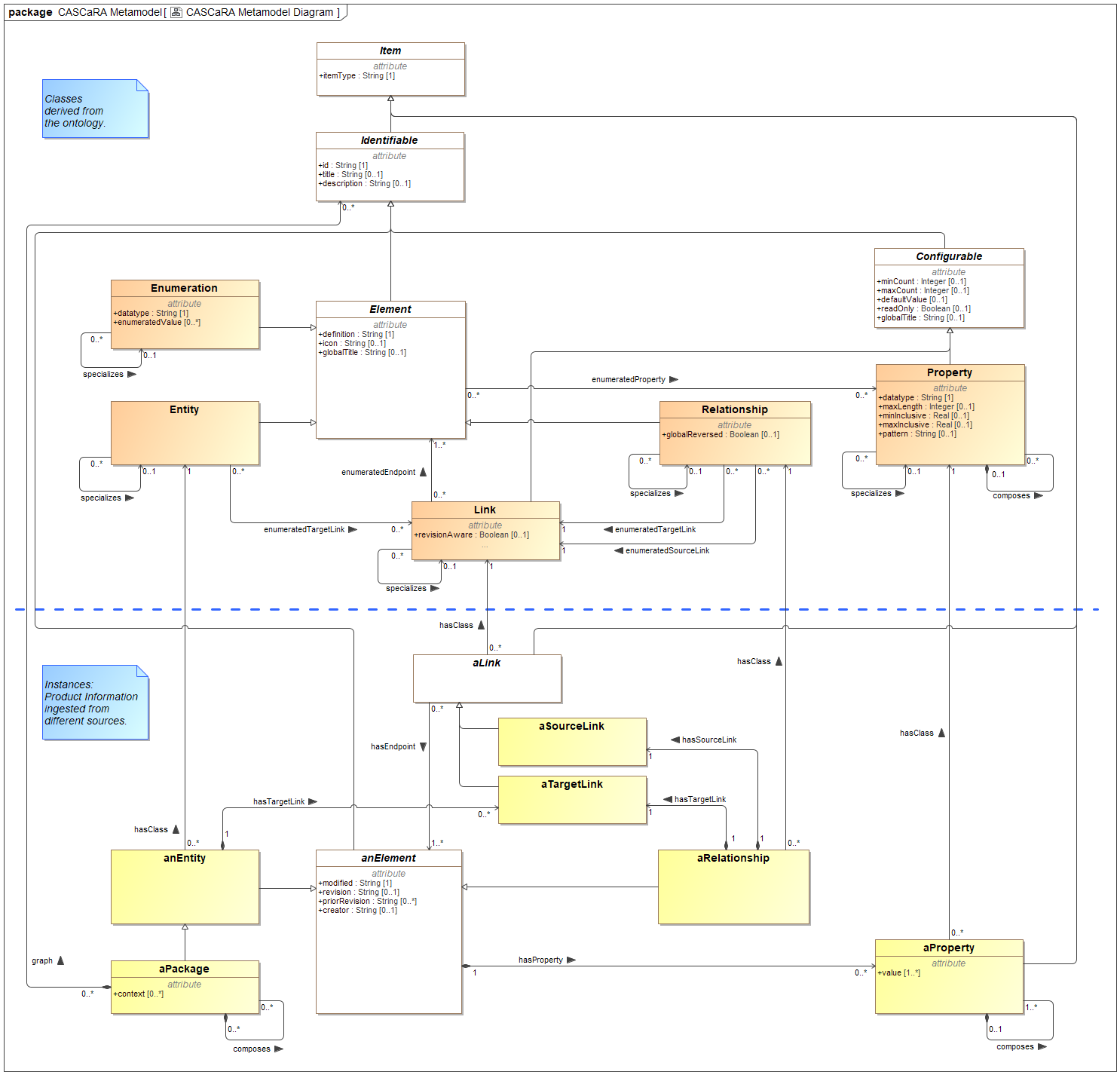
The metamodel is a 'platform independent model' (PIM) in OMG terms and defines both the classes (above the dashed line) and their instances (below the dashed line) for the CASCaRA Product Information Graph. Both the classes and the instances are data:
- Entity and anEntity are used for model elements, such as a requirement, a function or a system component.
- Relationship and aRelationship are used for relations between elements, such as a 'system component satisfies a requirement'. A relationship class may define the classes of entities or relationships, whose instances are eligible as source or target in a directed relationship.
- Every Entity and Relationship can define an individual set of Property, each of which specifies a data type and range. For example, a requirement might have three properties, such as a „Title“ with data type „String of max. length 96“, a „Description“ with data type „String“ without restriction and a „Priority“ with data type „String with a single choice of ['high', 'medium', 'low']“.
- A datatype may be any of those known from XML. As described above, some parameters may restrict the value range, such as minimum and/or maximum value of a number, a string length or a set of enumerated values.
- anEntity or aRelationship is an instance of Entity or Relationship respectively. Each instance usually has a set of aProperty corresponding with the Property of its class.
- aPackage is an instance of Entity and contains a subgraph of the global CASCaRA Graph; package instances can be nested. A package instance may have a set of aProperty corresponding with the Property of its class.
- "Technical" super-class and sub-class refer to the UML elements used in this metamodel by means of UML:Generalization.
- "Semantic" super-class and sub-class refer to associations between the real world instances of the metamodel items as specified by the UML associations named 'specializes'.
- As usual, the classes with white background and italic name are abstract.
- IDs are unique
- namespace prefixes are defined in the context
- Property.id is different from any of the native properties defined for all item types
- Property.hasClass is owl:DatatypeProperty (schema)
- Property.specializes is a Property
- Property.datatype is a valid xs: datatype
- Property.maxLength is >0 and only specified, if datatype is xs:string
- Property.pattern is a regular expression
- Property.minInclusive is only specified, if datatype is a xs: number datatype
- Property.maxInclusive is only specified, if datatype is a xs: number datatype
- Property.minInclusive is smaller or equal Property.maxInclusive
- Property datatype and range must be contained in those of the specialized Property (following the restrictions of OWL)
- Property.defaultValue meets datatype and range
- Property.composes entries are each pointing to a Property
- Property.composes chain is a tree (without cyclic dependency)
- Link.id is different from any of the native properties defined for all item types
- Link.hasClass is owl:ObjectProperty (schema)
- Link.specializes is a Link
- Link.enumeratedEndpoint entries point to either 1 Enumeration, 1..n Entities or 1..n Relationships
- Link.defaultValue is a valid Id-string (URI or UUID with namespace)
- Link.enumeratedEndpoints must be contained in or be subClasses of those of the specialized Link (following the restrictions of OWL)
- Enumeration.hasClass is owl:Class (schema)
- Enumeration.specializes is an Enumeration
- Enumeration.enumeratedValue comply with the datatype
- Entity.hasClass is owl:Class (schema)
- Entity.specializes is an Entity
- Entity.enumeratedProperty entries are each pointing to a Property
- Entity.enumeratedTargetLink entries are each pointing to a Link
- Relationship.hasClass is owl:Class (schema)
- Relationship.specializes is a Relationship
- Relationship.enumeratedSourceLink has exactly one entry pointing to a Link
- Relationship.enumeratedTargetLink has exactly one entry pointing to a Link
- aProperty is contained in a parent aPackage, anEntity or aRelationship
- aProperty.hasClass is a Property
- aProperty.hasClass is contained in enumeratedProperty list of its parent's class (Enumeration, Entity or Relationship)
- aProperty minCount and maxCount are met, language-aware in case of xs:string
- aProperty.value is represented/interpreted as string regardless of the datatype
- aProperty.value is a multilanguage object in case of xs:string, where the language tag is set if more than 1 language is provided
- aProperty.value datatype and range are met
- aProperty.composes entries are aProperty
- aSourceLink is contained in a parent aRelationship
- aSourceLink.hasClass is a Link
- aSourceLink.hasClass is contained in enumeratedSourceLink list of its parent's class (Relationship)
- aSourceLink.idRef points to an instance of the entries listed in its class' Link.enumeratedEndpoints
- aSourceLink must specify identifier and revision of the endpoints, if its class has revisionAware set to true
- aTargetLink is contained in a parent aPackage, anEntity or aRelationship
- aTargetLink.hasClass is a Link
- aTargetLink.idRef points either to an instance of the entries listed in its class' Link.enumeratedEndpoints or to an enumeratedValue of the listed Enumeration
- aTargetLink.hasClass is contained in enumeratedTargetLink list of its parent's class (Entity or Relationship)
- aTargetLink must specify identifier and revision of the endpoints, if its class has revisionAware set to true
- anEntity.hasClass is an Entity
- aRelationship.hasClass is a Relationship
- aPackage.hasClass is an Entity
- specializes chain is a tree (without cyclic dependency)
- Enumerations cannot be contained in a composed Property
- Links cannot be contained in a composed Property
- enumeratedEndpoints of a given Link must be of the same item type (Enumeration, Entity or Relationship)
- Access Permissions per user role are still missing. Role names and the way how to assign permissions per metamodel item shall be included in the standard, whereas the assignment of users to user roles is left to the implementations.
| Element Type | Diagram |
| Notation | UML Class Diagram |
☆ Item
The technical super-class of all CASCaRA metamodel items specifying the type of item to allow for simple schema checking and transformation.
Details:
- The class is abstract.
| Element Type | Class |
| CASCaRA Metamodel | contains | ☆ Item |
| ☆ Item | has part | ○ itemType |
| ▣ CASCaRA Metamodel Diagram | shows | ☆ Item |
| ☆ aLink ☆ aProperty ☆ Identifiable | specializes | ☆ Item |
○ itemType
Classifies classes and individuals (instances) in terms of this metamodel. It must be made explicit in all representations without native reasoner, such as in object-oriented programming, JSON, JSON-LD and XML. It can be omitted in RDF/OWL, as at the top of the class hierarchy there shall be a class corresponding to the metamodel itemType (see CASCARA Semantic Infrastructure and the itemType can be derived with a standard OWL reasoner.
Details:
- Here it is modeled as a string, but in fact it is an enumerated value from all concrete metamodel items (represented as UML classes), thus [Enumeration, Link, Property, Entity, Relationship, aPackage, aSourceLink, aTargetLink, aProperty, anEntity, aRelationship].
| Element Type | uml:Property |
| ☆ Item | has part | ○ itemType |
| ▣ CASCaRA Metamodel Diagram | shows | ○ itemType |
☆ Identifiable
All technical sub-classes of this class are identifiable, means they have an identifier, a title (name) and optionally a description.
Details:
- The class is abstract.
- All attributes are inherited by its subclasses.
- All class level items in the upper part of the diagram are commonly released and made available with an URL path including the revision. Hence, multiple revisions of the class set may exist in parallel.
- All instance level items in the lower part of the diagram may have individual revisions with their respective revision, modification date and creator. The prior revision identifier is memorized to support change history and branching. In case of a merge, there are two prior revisions.
| Element Type | Class |
| CASCaRA Metamodel | contains | ☆ Identifiable |
| ☆ aPackage | graph | ☆ Identifiable |
| ☆ Identifiable | has part | ○ description ○ id ○ title |
| ▣ CASCaRA Metamodel Diagram | shows | ☆ Identifiable |
| ☆ anElement ☆ Configurable ☆ Element | specializes | ☆ Identifiable |
| ☆ Identifiable | specializes | ☆ Item |
○ id
A globally unique identifier, either a fully qualified URI or a name with namespace standing for an URI, see aPackage context.
| Element Type | uml:Property |
| ☆ Identifiable | has part | ○ id |
| ▣ CASCaRA Metamodel Diagram | shows | ○ id |
○ title
A multiLanguageText. Maps to dcterms:title.
Details:
- Here a multiplicity [0..1] is given, but in fact that depends on the itemType.
- For all classes (Enumeration, Property, Link, Entity and Relationship), a title is mandatory.
- In case of anEntity at least one of title or description is required, because it must be possible to represent a text paragraph as anEntity, which simply does not have a title.
- In case of aRelationship both title and description are optional. If missing the title and/or description of the respective Relationship class applies. This avoids lots of repetition in real-world data-sets.
- The same applies for aProperty, aSourceLink and aTargetLink; both title and description are optional.
| Element Type | uml:Property |
| ☆ Identifiable | has part | ○ title |
| ▣ CASCaRA Metamodel Diagram | shows | ○ title |
○ description
A multiLanguageText. Maps to dcterms:description.
Details:
- Here a multiplicity [0..1] is given, but in fact that depends on the itemType.
- For all classes (Enumeration, Property, Link, Entity and Relationship), a title is mandatory.
- In case of anEntity at least one of title or description is required, because it must be possible to represent a text paragraph as anEntity, which simply does not have a title.
- In case of aRelationship both title and description are optional. If missing the title and/or description of the respective Relationship class applies. This avoids lots of repetition in real-world data-sets.
- The same applies for aProperty, aSourceLink and aTargetLink; both title and description are optional.
| Element Type | uml:Property |
| ☆ Identifiable | has part | ○ description |
| ▣ CASCaRA Metamodel Diagram | shows | ○ description |
☆ Element
A technical super-class of Entity (class of entities) and Relationship (class of relationships).
Details:
- The class is abstract.
- All attributes and associations are inherited by its technical sub-classes Entity and Relationship.
- The globalTitle of the Elements is used to integrate the instances of a partial graphs to an overarching CASCaRA graph.
| Element Type | Class |
| CASCaRA Metamodel | contains | ☆ Element |
| ☆ Link | enumeratedEndpoint | ☆ Element |
| ☆ Element | enumeratedProperty | ☆ Property |
| ☆ Element | has part | ○ definition ○ globalTitle ○ icon |
| ▣ CASCaRA Metamodel Diagram | shows | ☆ Element |
| ☆ Entity ☆ Enumeration ☆ Relationship | specializes | ☆ Element |
| ☆ Element | specializes | ☆ Identifiable |
○ definition
A multiLanguageText mandatory for all classes. Maps to skos:definition.
| Element Type | uml:Property |
| ☆ Element | has part | ○ definition |
| ▣ CASCaRA Metamodel Diagram | shows | ○ definition |
○ icon
An icon defined with a class can be used to decorate the instances.
Example:
- Folders as sub-class of Organizer and thus Entity may specify a UTF-8 character 🗀 for use by folders grouping certain model-elements.
- A data-URL of an icon is also permitted.
| Element Type | uml:Property |
| ☆ Element | has part | ○ icon |
| ▣ CASCaRA Metamodel Diagram | shows | ○ icon |
○ globalTitle
The title assigned by matching the title with the terms of the ontology by the 'globalize' operation.
| Element Type | uml:Property |
| ☆ Configurable ☆ Element | has part | ○ globalTitle |
| ▣ CASCaRA Metamodel Diagram | shows | ○ globalTitle |
☆ Enumeration
A class defining a set of enumerated values for use by any set of instances, where each value has an id and a value, either multiLanguageText in case of datatype xs:string or a simple value for all other datatypes.
A corresponding Link class must be defined with an enumeratedEndpoint to this enumeration class. An instance then has zero to many (0..n) aTargetLinks pointing to a value of the enumeration with hasTargetLink (not yet shown in the model diagram - this design is somewhat cumbersome and needs review). The required number of values is defined by minCount and maxCount of the Link class.
| Element Type | Class |
| CASCaRA Metamodel | contains | ☆ Enumeration |
| ☆ Enumeration | has part | ○ datatype ○ enumeratedValue |
| ▣ CASCaRA Metamodel Diagram | shows | ☆ Enumeration |
| ☆ Enumeration | specializes | ☆ Element ☆ Enumeration |
○ datatype
One of the xs: data types. Shall be anyURI.
| Element Type | uml:Property |
| ☆ Enumeration ☆ Property | has part | ○ datatype |
| ▣ CASCaRA Metamodel Diagram | shows | ○ datatype |
○ enumeratedValue
A defined value of an Enumeration.
Details:
- It must have the datatype specified by its parent.
- If the datatype is string, the value is a language string consisting of value and IETF language tag ('multiLangueText').
- Otherwise the value is a simple value.
- Values of all datatypes are represented as a string in all data formats, even JSON and JSON-LD.
| Element Type | uml:Property |
| ☆ Enumeration | has part | ○ enumeratedValue |
| ▣ CASCaRA Metamodel Diagram | shows | ○ enumeratedValue |
☆ Entity
Entity is a class of model elements, such as a system component or a requirement. An Entity is an owl:Class.
Details:
- Entity should have a title (name) and may have a description (definition).
- Entity may specify (configure) zero to many classes of properties its instances may have.
- The definitions of the entity together with those of the properties may be used to build user dialogs with input verification as well as to check its instances whether all property values have a correct type and value range as well as whether all required ones are present.
| Element Type | Class |
| CASCaRA Metamodel | contains | ☆ Entity |
| ☆ Entity | enumeratedTargetLink | ☆ Link |
| ☆ anEntity | hasClass | ☆ Entity |
| ▣ CASCaRA Metamodel Diagram | shows | ☆ Entity |
| ☆ Entity | specializes | ☆ Element ☆ Entity |
☆ Relationship
Relationship is a class of relationships between two entities to allow assertions such as 'a system component satisfies a requirement'. All relationships are bilateral and directed. This allows for statements according to propositional logic. They can be easily mapped to many technologies such as RDF or even ReqIF. Being reified, a Relationship is an owl:Class.
Details:
- Relationship must have a title (name) and may have a description (definition).
- Relationship lists zero to many property classes its instances may have.
- Relationship may define (configure) entitiy classes or relationship classes, whose instances are eligible as source resp. target in a relationship. If none are defined, all entities and relationships are eligible.
- Relationship is reified (as a rdfs:Resource in RDF), so that it can be a source or target of another Relationship - to make a statement on a statement.
- The definitions of a relationship together with those of their properties may be used to build user dialogs with input verfication and to check its instances whether all properties have a correct type and value range as well as whether all required ones are present.
| Element Type | Class |
| CASCaRA Metamodel | contains | ☆ Relationship |
| ☆ Relationship | enumeratedSourceLink | ☆ Link |
| ☆ Relationship | enumeratedTargetLink | ☆ Link |
| ☆ Relationship | has part | ○ globalReversed |
| ☆ aRelationship | hasClass | ☆ Relationship |
| ▣ CASCaRA Metamodel Diagram | shows | ☆ Relationship |
| ☆ Relationship | specializes | ☆ Element ☆ Relationship |
○ globalReversed
If set, the instances of the Relationship are interpreted in reverse direction when evaluated in the global graph.
Example:
- If the ontology defines a term 'satisfies', an incoming relationship named 'satisfied-by' is reversed and the globalTitle is set to 'satisfies' and globalReversed is set to 'true'.
| Element Type | uml:Property |
| ☆ Relationship | has part | ○ globalReversed |
| ▣ CASCaRA Metamodel Diagram | shows | ○ globalReversed |
☆ Configurable
Besides native properties such as title and description, Elements can have configurable properties and links. Those configurable properties and links support a dynamic data model, so that the ontology can evolve over time without software change. Sufficient detail such as data type and range can be provided to build dynamic forms, for example. It is in fact the core feature to separate CASCaRA syntax and semantics.
Details:
- This class is abstract
| Element Type | Class |
| CASCaRA Metamodel | contains | ☆ Configurable |
| ☆ Configurable | has part | ○ defaultValue ○ globalTitle ○ maxCount ○ minCount ○ readOnly |
| ▣ CASCaRA Metamodel Diagram | shows | ☆ Configurable |
| ☆ Link ☆ Property | specializes | ☆ Configurable |
| ☆ Configurable | specializes | ☆ Identifiable |
○ minCount
An instance must have at least this number of properties of this class. Is '0' by default. This applies to both instances of a Property class and a Link class.
For example, if a property class 'Priority' has a minCount=1 and a requirement class specifies an enumeratedProperty 'Priority', a requirement instance must have at least one property of class Priority (with a value).
| Element Type | uml:Property |
| ☆ Configurable ☆ Link | has part | ○ minCount |
| ▣ CASCaRA Metamodel Diagram | shows | ○ minCount |
○ maxCount
An instance must have at most this number of properties of this class. Is unbounded (infinite) by default. This applies to both instances of a Property class and a Link class.
For example, if a property class 'Priority' has a maxCount=1 and a requirement class specifies an enumeratedProperty 'Priority', a requirement instance must have no more than one property of class Priority (with a value).
| Element Type | uml:Property |
| ☆ Configurable ☆ Link | has part | ○ maxCount |
| ▣ CASCaRA Metamodel Diagram | shows | ○ maxCount |
○ defaultValue
Optional default value(s) in case a modelElement's property does not have an individual value when instantiated. It may be changed later on and must follow the definitions of the PropertyClass resp. LinkClass at all times, of course.
Here, the attribute is named 'defaultValue' for clarity and may just be called 'value' in an implementation, as all restrictions and operations of a property's value apply.
| Element Type | uml:Property |
| ☆ Configurable ☆ Link | has part | ○ defaultValue |
| ▣ CASCaRA Metamodel Diagram | shows | ○ defaultValue |
○ readOnly
The link value of an instance may not be updated or deleted, once assigned.
| Element Type | uml:Property |
| ☆ Configurable ☆ Link | has part | ○ readOnly |
| ▣ CASCaRA Metamodel Diagram | shows | ○ readOnly |
○ globalTitle
The title assigned by matching the title with the terms of the ontology by the 'globalize' operation.
| Element Type | uml:Property |
| ☆ Configurable ☆ Element | has part | ○ globalTitle |
| ▣ CASCaRA Metamodel Diagram | shows | ○ globalTitle |
☆ Property
Every class Entity and Relationship can have an individual set of configurable properties, each of which is uniquely defined by datatype and range. A Property is an owl:ObjectProperty when enumeratedValues are defined and is an owl:DatatypeProperty otherwise.
Example: A requirement might have a list with three properties, such as
- Title with data type „String of max. length 96“,
- Description with data type „String“ wíthout length restriction and
- Priority with data type „String with a single choice of ['high', 'medium', 'low']“.
Details:
- Property class must have a title and may have a description named.
- Property class may define a minimum and maximum count of values.
- Property class must define a datatype and may restrict its range by minInclusive, maxInclusive or or a pattern defined by Regular Expression.
- Property class may define a set of enumerated values which must of course satisfy its own data type and range
- A property class may define a default value which must of course satisfy its own data type and range.
- Property class may be composed of multiple property classes to form a structured data type (xs:complexType). The structure must be a tree, thus without cyclic dependency.
| Element Type | Class |
| ☆ Property | composes | ☆ Property |
| CASCaRA Metamodel | contains | ☆ Property |
| ☆ Element | enumeratedProperty | ☆ Property |
| ☆ Property | has part | ○ datatype ○ maxInclusive ○ maxLength ○ minInclusive ○ pattern |
| ☆ aProperty | hasClass | ☆ Property |
| ▣ CASCaRA Metamodel Diagram | shows | ☆ Property |
| ☆ Property | specializes | ☆ Configurable ☆ Property |
○ datatype
One of the xs: data types. Shall be anyURI.
| Element Type | uml:Property |
| ☆ Enumeration ☆ Property | has part | ○ datatype |
| ▣ CASCaRA Metamodel Diagram | shows | ○ datatype |
○ maxLength
Maximum length of a property value with datatype 'xs:string'. Is not allowed with any other datatype.
| Element Type | uml:Property |
| ☆ Property | has part | ○ maxLength |
| ▣ CASCaRA Metamodel Diagram | shows | ○ maxLength |
○ minInclusive
The minimum value a property of this type may have. May be applied only for numeric datatypes. It the intrinsic minimum value of the datatype by default.
| Element Type | uml:Property |
| ☆ Property | has part | ○ minInclusive |
| ▣ CASCaRA Metamodel Diagram | shows | ○ minInclusive |
○ maxInclusive
The maximum value a property of this type may have. May be applied only for numeric datatypes. It the intrinsic maximum value of the datatype by default.
| Element Type | uml:Property |
| ☆ Property | has part | ○ maxInclusive |
| ▣ CASCaRA Metamodel Diagram | shows | ○ maxInclusive |
○ pattern
A Regular Expression that must evaluate successfully with the property value. Can also be used to limit the number of decimals of a number, as there is no restriction like xs:fractionDigits in SHACL.
| Element Type | uml:Property |
| ☆ Property | has part | ○ pattern |
| ▣ CASCaRA Metamodel Diagram | shows | ○ pattern |
☆ Link
A Link is an identifiable link class. A Link is an owl:ObjectProperty.
Example:
- An Organizer (semantic sub-class of Entity) may list Model-Elements (another semantic sub-class of Entity) to provide a document outline.
- As such the Link class lists is specified as enumeratedTargetLink by Organizer.
| Element Type | Class |
| CASCaRA Metamodel | contains | ☆ Link |
| ☆ Link | enumeratedEndpoint | ☆ Element |
| ☆ Relationship | enumeratedSourceLink | ☆ Link |
| ☆ Entity ☆ Relationship | enumeratedTargetLink | ☆ Link |
| ☆ Link | has part | ○ defaultValue ○ maxCount ○ minCount ○ readOnly ○ revisionAware |
| ☆ aLink | hasClass | ☆ Link |
| ▣ CASCaRA Metamodel Diagram | shows | ☆ Link |
| ☆ Link | specializes | ☆ Configurable ☆ Link |
○ minCount
An instance must have at least this number of properties of this class. Is '0' by default. This applies to both instances of a Property class and a Link class.
For example, if a property class 'Priority' has a minCount=1 and a requirement class specifies an enumeratedProperty 'Priority', a requirement instance must have at least one property of class Priority (with a value).
| Element Type | uml:Property |
| ☆ Configurable ☆ Link | has part | ○ minCount |
| ▣ CASCaRA Metamodel Diagram | shows | ○ minCount |
○ maxCount
An instance must have at most this number of properties of this class. Is unbounded (infinite) by default. This applies to both instances of a Property class and a Link class.
For example, if a property class 'Priority' has a maxCount=1 and a requirement class specifies an enumeratedProperty 'Priority', a requirement instance must have no more than one property of class Priority (with a value).
| Element Type | uml:Property |
| ☆ Configurable ☆ Link | has part | ○ maxCount |
| ▣ CASCaRA Metamodel Diagram | shows | ○ maxCount |
○ revisionAware
Indicates whether an instance of this class points to a specific or any revision of the specified endpoint. In case of the former, the key of such a link instance must contain both identifier and revision. Default is false, so the relationship points to any revision of the endpoint; in that case the key only contains just the identifier.
Examples:
- A 'lists' link of an outline shall continue to apply to an endpoint, even if updated. So revisionAware is omitted or set to 'false'.
- A 'verifies' relation shall apply between specific revisions of a test-case and a requirement. So the classes of both aSourceLink and aTargetLink set revisionAware to 'true'. If the requirement is updated, it does not have a 'verifies' link, until explicitly set after repeating the test-case.
- Of course, only one of the link classes of a Relationship class can be 'revisionAware'.
| Element Type | uml:Property |
| ☆ Link | has part | ○ revisionAware |
| ▣ CASCaRA Metamodel Diagram | shows | ○ revisionAware |
○ defaultValue
Optional default value(s) in case a modelElement's property does not have an individual value when instantiated. It may be changed later on and must follow the definitions of the PropertyClass resp. LinkClass at all times, of course.
Here, the attribute is named 'defaultValue' for clarity and may just be called 'value' in an implementation, as all restrictions and operations of a property's value apply.
| Element Type | uml:Property |
| ☆ Configurable ☆ Link | has part | ○ defaultValue |
| ▣ CASCaRA Metamodel Diagram | shows | ○ defaultValue |
○ readOnly
The link value of an instance may not be updated or deleted, once assigned.
| Element Type | uml:Property |
| ☆ Configurable ☆ Link | has part | ○ readOnly |
| ▣ CASCaRA Metamodel Diagram | shows | ○ readOnly |
☆ aPackage
A container for any selection of metamodel items. Standardized and addressable classes can be excluded from aPackage. Thus aPackage contains specific classes (from organization or project ontologies) plus the instances of interest.
Details:
- The class of aPackage is formally Entity, but should be a subclass of Organizer (see CASCaRA Semantic Infrastructure).
- aPackage can be nested.
- Additional properties such as license, contributor or import nested packages are enumerated in the class of Package.
| Element Type | Class |
| ☆ aPackage | composes | ☆ aPackage |
| CASCaRA Metamodel | contains | ☆ aPackage |
| ☆ aPackage | graph | ☆ Identifiable |
| ☆ aPackage | has part | ○ context |
| ▣ CASCaRA Metamodel Diagram | shows | ☆ aPackage |
| ☆ aPackage | specializes | ☆ anEntity |
○ context
A list of IRIs per namespace abbreviation. Used as sequence of @prefix in RDF/Turtle, sequence of xmlns: in XML and @context in JSON-LD.
| Element Type | uml:Property |
| ☆ aPackage | has part | ○ context |
| ▣ CASCaRA Metamodel Diagram | shows | ○ context |
☆ anElement
A technical superclass of anEntity and aRelationship.
Details:
- The class is abstract.
- All attributes and associations are inherited by its sub-classes.
- Sub-classes may have individual revisions with revision id, modification date and creator. The prior revision id is memorized to support change history and branching. In case of a merge, there are two prior revisions.
| Element Type | Class |
| CASCaRA Metamodel | contains | ☆ anElement |
| ☆ anElement | has part | ○ creator ○ modified ○ priorRevision ○ revision |
| ☆ aLink | hasEndpoint | ☆ anElement |
| ☆ anElement | hasProperty | ☆ aProperty |
| ▣ CASCaRA Metamodel Diagram | shows | ☆ anElement |
| ☆ anEntity ☆ aRelationship | specializes | ☆ anElement |
| ☆ anElement | specializes | ☆ Identifiable |
○ modified
A ISO-8601 DateTime value recording the point in time of the last change.
| Element Type | uml:Property |
| ☆ anElement | has part | ○ modified |
| ▣ CASCaRA Metamodel Diagram | shows | ○ modified |
○ revision
A unique string identifying the revision of the entity or relationship instance.
| Element Type | uml:Property |
| ☆ anElement | has part | ○ revision |
| ▣ CASCaRA Metamodel Diagram | shows | ○ revision |
○ priorRevision
Links to the previous revisions of an entity or relationship instance. It is a list with
- zero elements, if it is the first revision,
- one element for a subsequent revision or
- two elements when two branches are merged.
| Element Type | uml:Property |
| ☆ anElement | has part | ○ priorRevision |
| ▣ CASCaRA Metamodel Diagram | shows | ○ priorRevision |
○ creator
The person committing the last change. Is often an e-mail address.
| Element Type | uml:Property |
| ☆ anElement | has part | ○ creator |
| ▣ CASCaRA Metamodel Diagram | shows | ○ creator |
☆ anEntity
Is used for instances of model-elements such as a system component or a requirement. Is 'payload' having a clear meaning through the respective Entity class.
Details:
- An entity must have either a title or a description - or both. This allows to compose documents including text paragraphs without title.
- The entity's class enumerates the classes of properties it may have.
| Element Type | Class |
| CASCaRA Metamodel | contains | ☆ anEntity |
| ☆ anEntity | hasClass | ☆ Entity |
| ☆ anEntity | hasTargetLink | ☆ aTargetLink |
| ▣ CASCaRA Metamodel Diagram | shows | ☆ anEntity |
| ☆ aPackage | specializes | ☆ anEntity |
| ☆ anEntity | specializes | ☆ anElement |
☆ aRelationship
Is used for relations between entities, such as a 'system component satisfies a requirement'. All relationships are bilateral and directed. Is 'payload' having a clear meaning through the respective Relationship class.
Details:
- This is a reified graph edge and must have exactly one source and target entity each. The source must be an entity or relationship with a class defined by an eligible source class of its Relationship. The same applies for the target.
- Even though a relationship instance may have an individual title, it is advised to omit it and assume its class' title when needed to assure that relationships of the same class are named equally.
- The relationship's class enumerates the classes of properties it may have.
| Element Type | Class |
| CASCaRA Metamodel | contains | ☆ aRelationship |
| ☆ aRelationship | hasClass | ☆ Relationship |
| ☆ aRelationship | hasSourceLink | ☆ aSourceLink |
| ☆ aRelationship | hasTargetLink | ☆ aTargetLink |
| ▣ CASCaRA Metamodel Diagram | shows | ☆ aRelationship |
| ☆ aRelationship | specializes | ☆ anElement |
☆ aProperty
Each property belongs to a single anEntity, aRelationship or aPackage. A property has no identifier, thus a property update results in a new revision of the item to which it belongs. Is 'payload' having a clear meaning, datatype and range through the respective Property class.
Details:
- A property may be required or not depending on the attributes minCount and maxCount of its class, but an existing property must have a value.
- A property may be composed of multiple properties to form a structured data set according to its Property class.
| Element Type | Class |
| ☆ aProperty | composes | ☆ aProperty |
| CASCaRA Metamodel | contains | ☆ aProperty |
| ☆ aProperty | has part | ○ value |
| ☆ aProperty | hasClass | ☆ Property |
| ☆ anElement | hasProperty | ☆ aProperty |
| ▣ CASCaRA Metamodel Diagram | shows | ☆ aProperty |
| ☆ aProperty | specializes | ☆ Item |
○ value
The value of a property.
Details:
- If the datatype of the property's class is string, the value is a language string consisting of value and IETF language tag ('multiLangueText').
- Otherwise the value is a simple value.
- Values of all datatypes are represented as a string in all data formats, even JSON and JSON-LD.
| Element Type | uml:Property |
| ☆ aProperty | has part | ○ value |
| ▣ CASCaRA Metamodel Diagram | shows | ○ value |
☆ aLink
Is a technical super-class for link instances.
Details:
- The class is abstract.
- A list of enumerated endpoints (references) per link instance is possible.
- If the class is set to versionAware, all pointers to an endpoint must contain both identifier and revision.
| Element Type | Class |
| CASCaRA Metamodel | contains | ☆ aLink |
| ☆ aLink | hasClass | ☆ Link |
| ☆ aLink | hasEndpoint | ☆ anElement |
| ▣ CASCaRA Metamodel Diagram | shows | ☆ aLink |
| ☆ aSourceLink ☆ aTargetLink | specializes | ☆ aLink |
| ☆ aLink | specializes | ☆ Item |
☆ aSourceLink
A link instance serving as source for a reified relationship.
From a semantic point of view, there is no need to make a distinction between aSourceLink and aTargetLink at the metamodel level. The distinction can be done and is made at ontology level in the CASCaRA Semantic Infrastructure. However it is much easier to check the pattern/schema/shape and to ingest data, if the itemType is explicit.
Details:
- aSourceLink may be required or not depending on the attributes minCount and maxCount of its class, but an existing one must have a value.
Example:
- A single 'satisfies' relationship can relate one or many function instances to a requirement instance.
| Element Type | Class |
| CASCaRA Metamodel | contains | ☆ aSourceLink |
| ☆ aRelationship | hasSourceLink | ☆ aSourceLink |
| ▣ CASCaRA Metamodel Diagram | shows | ☆ aSourceLink |
| ☆ aSourceLink | specializes | ☆ aLink |
☆ aTargetLink
A link instance pointing to the target of a reified aRelationship or to one or more targets of anEntity.
From a semantic point of view, there is no need to make a distinction between aSourceLink and aTargetLink at the metamodel level. The distinction can be done and is made at ontology level in the CASCaRA Semantic Infrastructure. However it is much easier to check the pattern/schema/shape and to ingest data, if the itemType is explicit.
Details:
- aTargetLink may be required or not depending on the attributes minCount and maxCount of its class, but an existing one must have a value.
Example:
- A 'satisfies' relationship can relate a function instance to one or multiple requirement instances (targets).
- An organizer (see CASCaRA Semantic Infrastructure) such as a chapter title (folder) in an outline can point to one or more contained items, be it anEntity or aRelationship or other.
- anEntity, aRelationship or aPackage may point to value of an Enumeration.
| Element Type | Class |
| CASCaRA Metamodel | contains | ☆ aTargetLink |
| ☆ anEntity ☆ aRelationship | hasTargetLink | ☆ aTargetLink |
| ▣ CASCaRA Metamodel Diagram | shows | ☆ aTargetLink |
| ☆ aTargetLink | specializes | ☆ aLink |
CASCaRA Semantic Infrastructure
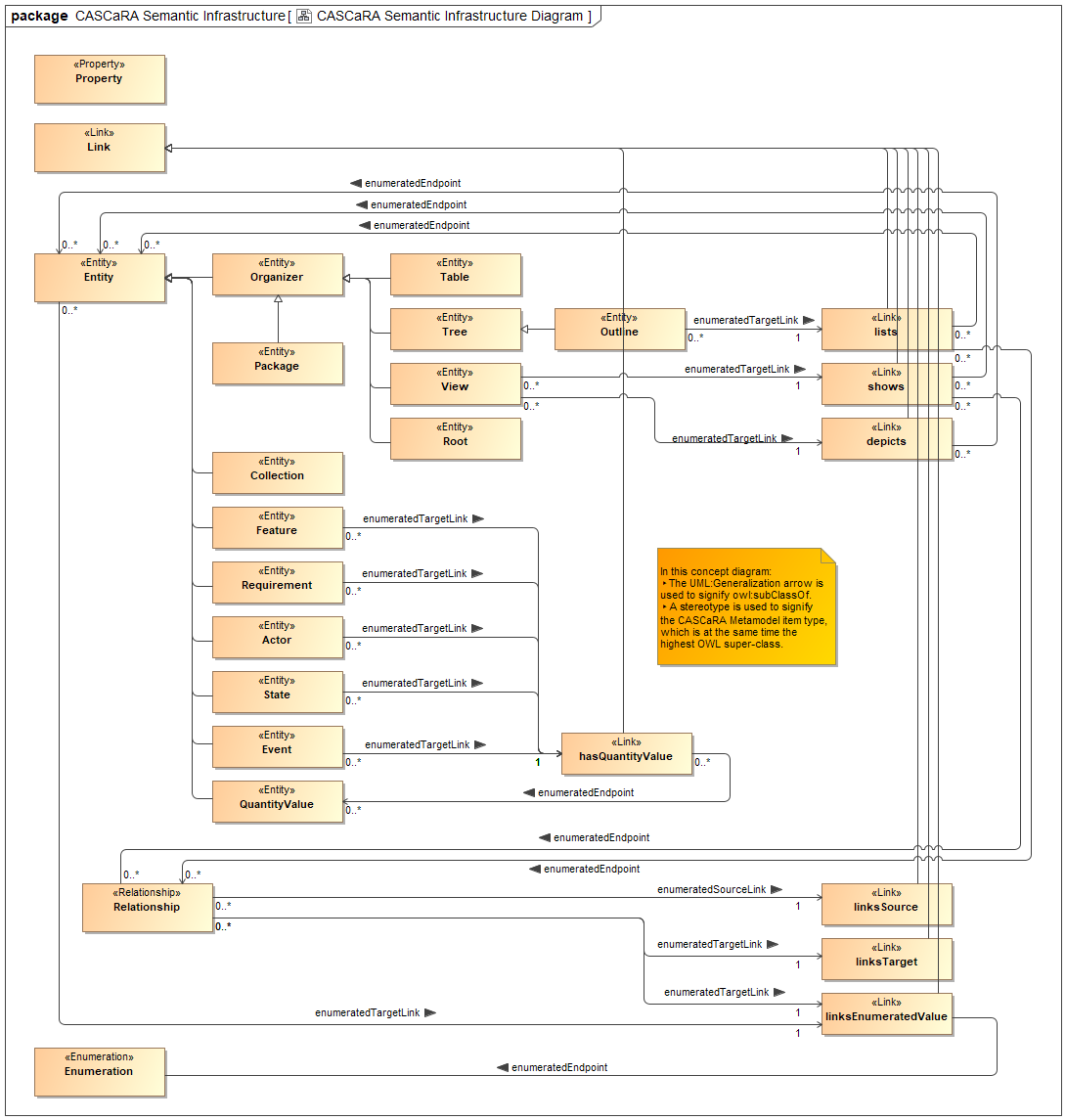
The CASCaRA Semantic Infrastructure complements the CASCaRA Metamodel by further sub-classing its items. The idea is to keep the metamodel as simple as possible and add semantic precision through the semantic infrastructure.
Let's consider the paradigma of separating syntax and semantics with the objective to shield the software from an ontology under evolution over time. In all likelihood, the CASCaRA Semantic Infrastructure will be used by software for reasons of simplicity. Therefore it is advised to treat the semantic infrastructure similarly to the metamodel: Change it seldomly and keep it downward compatible. Thus, software built assuming an older version shall not break when a new version is adopted. So the semantic infrastructure can be seen as an intermediary layer between metamodel and ontology which is managed like the metamodel.
Thus, an ontology for use with the CASCaRA Metamodel SHOULD sub-class the items of the CASCaRA Semantic Infrastructure.
| Element Type | Package |
| CASCaRA Semantic Infrastructure | contains | ☆ depicts ☆ Enumeration ☆ hasQuantityValue ☆ Link ☆ linksEnumeratedValue ☆ linksSource ☆ linksTarget ☆ lists ☆ Property ☆ shows ▣ CASCaRA Semantic Infrastructure Diagram |
▣ CASCaRA Semantic Infrastructure Diagram
The diagram illustrates the concept, but is by no means complete. Consult the data in CASCaRA JSON-LD, XML or TTL format to get a complete representation.
| Element Type | Diagram |
| Notation | UML Class Diagram |
| CASCaRA Semantic Infrastructure | contains | ▣ CASCaRA Semantic Infrastructure Diagram |
| ▣ CASCaRA Semantic Infrastructure Diagram | shows | ☆ depicts ☆ Enumeration ☆ hasQuantityValue ☆ Link ☆ linksEnumeratedValue ☆ linksSource ☆ linksTarget ☆ lists ☆ Property ☆ shows Actor Collection Entity Event Feature Organizer Outline Package QuantityValue Relationship Requirement Root State Table Tree View |
Entity
The semantic foundation for all Entity (class) definitions. Is an owl:Class.
| Element Type | Class |
| ☆ depicts ☆ lists ☆ shows | enumeratedEndpoint | Entity |
| Entity | enumeratedTargetLink | ☆ linksEnumeratedValue |
| ▣ CASCaRA Semantic Infrastructure Diagram | shows | Entity |
| Actor Collection Event Feature Organizer QuantityValue Requirement State | specializes | Entity |
Relationship
The semantic foundation for all Relationship (class) definitions. Is an owl:Class.
| Element Type | Class |
| ☆ lists | enumeratedEndpoint | Relationship |
| Relationship | enumeratedSourceLink | ☆ linksSource |
| Relationship | enumeratedTargetLink | ☆ linksEnumeratedValue ☆ linksTarget |
| ▣ CASCaRA Semantic Infrastructure Diagram | shows | Relationship |
☆ Property
The semantic foundation for all Property (class) definitions. Is an owl:DatatypeProperty.
| Element Type | cas:Property |
| CASCaRA Semantic Infrastructure | contains | ☆ Property |
| ▣ CASCaRA Semantic Infrastructure Diagram | shows | ☆ Property |
☆ Link
The semantic foundation for all Link (class) definitions. Is an owl:ObjectProperty.
| Element Type | cas:Link |
| CASCaRA Semantic Infrastructure | contains | ☆ Link |
| ▣ CASCaRA Semantic Infrastructure Diagram | shows | ☆ Link |
| ☆ depicts ☆ hasQuantityValue ☆ linksEnumeratedValue ☆ linksSource ☆ linksTarget ☆ lists ☆ shows | specializes | ☆ Link |
Organizer
An Organizer is about presenting genuine a selection of model-elements for a given target group of users, for example a document outline, a table or a diagram.
| Element Type | Class |
| ▣ CASCaRA Semantic Infrastructure Diagram ▣ Entity with Property ▣ Very Simple Model with Requirements | shows | Organizer |
| Package Root Table Tree View | specializes | Organizer |
| Organizer | specializes | Entity |
Tree
A specialized Organizer with elements (nodes) arranged in a strictly hierarchical manner. Any element SHALL contain a reference to any Entity or Relationship.
| Element Type | Class |
| ▣ CASCaRA Semantic Infrastructure Diagram ▣ Very Simple Model with Requirements | shows | Tree |
| Outline | specializes | Tree |
| Tree | specializes | Organizer |
Outline
A tree (hierarchical arrangement) of references to graph nodes (vertices) to create a reading sequence. Graph nodes include Entity and Relationship. Outline is used at any level of the tree like a directory folder or universally for section, chapter and paragraph of a document.
| Element Type | Class |
| Outline | enumeratedTargetLink | ☆ lists |
| ☆ Glossary ☆ Introduction ☆ Requirements ☆ System Diagrams | hasClass | Outline |
| ▣ CASCaRA Semantic Infrastructure Diagram ▣ Very Simple Model with Requirements | shows | Outline |
| Outline | specializes | Tree |
View
A specialized Organizer with elements displayed in two or three dimensions such as a model-diagram, 3D visualization or pie-chart. Any element SHOULD reference any instance of Entity or Relationship.
| Element Type | Class |
| View | enumeratedProperty | ☆ Category |
| View | enumeratedTargetLink | ☆ depicts ☆ shows |
| ☆ FiCo Architecture Diagram | hasClass | View |
| ▣ CASCaRA Semantic Infrastructure Diagram ▣ Entity with Property ▣ Very Simple Model with Requirements | shows | View |
| View | specializes | Organizer |
Table
A specialized Organizer with elements (cells) arranged two-dimensionally in columns and rows. Any element SHALL contain a reference to any Entity or Relationship.
| Element Type | Class |
| ▣ CASCaRA Semantic Infrastructure Diagram | shows | Table |
| Table | specializes | Organizer |
Package
A Package contains a given selection of CASCaRA items (classes and instances) for a given purpose, such as a component specification for review or in a customer-supplier relationship.
| Element Type | Class |
| ▣ CASCaRA Semantic Infrastructure Diagram | shows | Package |
| Package | specializes | Organizer |
Root
A root class serves to anchor organizer structures in a data package. While a graph has no start and no end, a root instance with a subordinated organizer structure offers a way to explore the graph for a given purpose.
Example:
- A document outline anchored at a root element would define a document to read by auditors and perhaps another one for potential customers.
- When querying all instances of class Root, a list of available documents is returned.
| Element Type | Class |
| ☆ Hierarchy Root | hasClass | Root |
| ▣ CASCaRA Semantic Infrastructure Diagram ▣ Very Simple Model with Requirements | shows | Root |
| Root | specializes | Organizer |
Collection
A 'Collection' is a logical (often conceptual) group of resources linked with a relationship (tbd). It corresponds to a 'Group' in BPMN or a 'Grouping' in ArchiMate.
- BPMN: An arbitrary set of objects can be defined as a Group to show that they logically belong together. Source: BPMN Tutorial.
- ArchiMate: The grouping element aggregates or composes concepts that belong together based on some common characteristic. Source: ArchiMate® 3.2 Specification.
| Element Type | Class |
| ▣ CASCaRA Semantic Infrastructure Diagram | shows | Collection |
| Collection | specializes | Entity |
☆ Enumeration
The semantic foundation for all Enumeration (class) definitions. Is an owl:Class. Has a finite list of values for Properties.
| Element Type | cas:Enumeration |
| CASCaRA Semantic Infrastructure | contains | ☆ Enumeration |
| ▣ CASCaRA Semantic Infrastructure Diagram | shows | ☆ Enumeration |
Feature
A 'Feature' is an intentional distinguishing characteristic of a system, often a unique selling proposition.
| Element Type | Class |
| Feature | enumeratedTargetLink | ☆ hasQuantityValue |
| ▣ CASCaRA Semantic Infrastructure Diagram | shows | Feature |
| Feature | specializes | Entity |
Requirement
A 'Requirement' is a singular documented physical and functional need that a particular design, product or process must be able to perform. (source: Wikipedia)
| Element Type | Class |
| ☆ satisfies-toTarget | enumeratedEndpoint | Requirement |
| Requirement | enumeratedTargetLink | ☆ hasQuantityValue ☆ Priority |
| ☆ Consistency ☆ Data Volume ☆ Response Time | hasClass | Requirement |
| ▣ CASCaRA Semantic Infrastructure Diagram ▣ Entity with Property having Enumerated Values ▣ Very Simple Model with Requirements | shows | Requirement |
| Requirement | specializes | Entity |
Actor
An 'Actor' is a fundamental model element type representing an active entity, be it an activity, a process step, a function, a system component or a role.
| Element Type | Class |
| Actor | enumeratedTargetLink | ☆ hasQuantityValue |
| ☆ FiCo Application | hasClass | Actor |
| ▣ CASCaRA Semantic Infrastructure Diagram ▣ Very Simple Model with Requirements | shows | Actor |
| Actor | specializes | Entity |
State
A 'State' is a fundamental model element type representing a passive entity, be it a value, a condition, an information storage or even a physical shape.
| Element Type | Class |
| State | enumeratedTargetLink | ☆ hasQuantityValue |
| ☆ FiCo Data | hasClass | State |
| ▣ CASCaRA Semantic Infrastructure Diagram ▣ Very Simple Model with Requirements | shows | State |
| State | specializes | Entity |
Event
An 'Event' is a fundamental model element type representing a time reference, a change in condition/value or more generally a synchronization primitive.
| Element Type | Class |
| Event | enumeratedTargetLink | ☆ hasQuantityValue |
| ▣ CASCaRA Semantic Infrastructure Diagram | shows | Event |
| Event | specializes | Entity |
QuantityValue
A dimensioned quantity with two properties, a 'quantity' (a numeric value) and a 'unit' of measurement.
| Element Type | Class |
| ☆ hasQuantityValue | enumeratedEndpoint | QuantityValue |
| ▣ CASCaRA Semantic Infrastructure Diagram | shows | QuantityValue |
| QuantityValue | specializes | Entity |
☆ shows
A Link class for use by View to enumerate eligible Entity and/or Relationship classes that are visible on a view (e.g. model-diagram).
| Element Type | cas:Link |
| CASCaRA Semantic Infrastructure | contains | ☆ shows |
| ☆ shows | enumeratedEndpoint | Entity |
| View | enumeratedTargetLink | ☆ shows |
| ▣ CASCaRA Semantic Infrastructure Diagram | shows | ☆ shows |
| ☆ shows | specializes | ☆ Link |
☆ lists
A Link class for use by Outline to enumerate eligible Entity and/or Relationship classes.
| Element Type | cas:Link |
| CASCaRA Semantic Infrastructure | contains | ☆ lists |
| ☆ lists | enumeratedEndpoint | Entity Relationship |
| Outline | enumeratedTargetLink | ☆ lists |
| ▣ CASCaRA Semantic Infrastructure Diagram | shows | ☆ lists |
| ☆ lists | specializes | ☆ Link |
☆ depicts
A Link class for use by View to enumerate eligible Entity and/or Relationship classes that can own a view (e.g. a state diagram describing the behavior of a component where the latter owns the depicting view).
| Element Type | cas:Link |
| CASCaRA Semantic Infrastructure | contains | ☆ depicts |
| ☆ depicts | enumeratedEndpoint | Entity |
| View | enumeratedTargetLink | ☆ depicts |
| ▣ CASCaRA Semantic Infrastructure Diagram | shows | ☆ depicts |
| ☆ depicts | specializes | ☆ Link |
☆ linksSource
A Link subclass for use by Relationship to enumerate eligible Entity and/or Relationship classes that can serve as a source.
Example:
- By further specializing this class, a speaking title can be given to a sourceLink, such as 'employee' in a 'worksFor' relationship being a specialization of Relationship.
| Element Type | cas:Link |
| CASCaRA Semantic Infrastructure | contains | ☆ linksSource |
| Relationship | enumeratedSourceLink | ☆ linksSource |
| ▣ CASCaRA Semantic Infrastructure Diagram | shows | ☆ linksSource |
| ☆ linksSource | specializes | ☆ Link |
☆ linksTarget
A Link subclass for use by Relationship to enumerate eligible Entity and/or Relationship classes that can serve as a target.
Example:
- By further specializing this class, a meaningful title can be given to a sourceLink, such as 'employer' in a 'worksFor' relationship being a specialization of Relationship.
| Element Type | cas:Link |
| CASCaRA Example CASCaRA Semantic Infrastructure | contains | ☆ linksTarget |
| Relationship | enumeratedTargetLink | ☆ linksTarget |
| ▣ CASCaRA Semantic Infrastructure Diagram ▣ Entity with Property having Enumerated Values | shows | ☆ linksTarget |
| ☆ Priority | specializes | ☆ linksTarget |
| ☆ linksTarget | specializes | ☆ Link |
☆ linksEnumeratedValue
A Link subclass for use by an Entity or Relationship to enumerate eligible Enumeration classes that can serve as a target.
Example:
- A Requirement specifies a priority, where the priority values are defined in an Enumeration class and the link to use as linksEnumeration.
- A meaningful link name such as 'has Priority' can be created through a subclass of linksEnumeration.
| Element Type | cas:Link |
| CASCaRA Semantic Infrastructure | contains | ☆ linksEnumeratedValue |
| Entity Relationship | enumeratedTargetLink | ☆ linksEnumeratedValue |
| ▣ CASCaRA Semantic Infrastructure Diagram | shows | ☆ linksEnumeratedValue |
| ☆ linksEnumeratedValue | specializes | ☆ Link |
☆ hasQuantityValue
| Element Type | cas:Link |
| CASCaRA Semantic Infrastructure | contains | ☆ hasQuantityValue |
| ☆ hasQuantityValue | enumeratedEndpoint | QuantityValue |
| Actor Event Feature Requirement State | enumeratedTargetLink | ☆ hasQuantityValue |
| ▣ CASCaRA Semantic Infrastructure Diagram | shows | ☆ hasQuantityValue |
| ☆ hasQuantityValue | specializes | ☆ Link |
CASCaRA Schemata
Schemata are (resp. will be) made available for the native CASCaRA formats; they are 'Platform Specific Models' (PSM) in OMG terms:
- JSON-Schema for CASCaRA JSON-LD.
- XML-Schema (XSD) for CASCaRA XML (in preparation)
- RDF (in preparation, while it is not yet clear how to formulate the CASCaRA metamodel and its constraints in SPARQL, SHACL or other).
Note: Schemata can only check the format of a data-set. Constraints apply in addition. Please refer to the Metamodel chapter above.
| Element Type | Package |
CASCaRA Example
A simple, yet representative CASCaRA example is presented. This chapter decribes it, whereas the data is listed in the four native CASCaRA formats:
- CASCaRA XML, see Annex A.1 or Very Simple Model with Requirements (XML).
- CASCaRA JSON-LD, see Annex A.2 or Very Simple Model with Requirements (JSON-LD).
- CASCaRA XML, see Annex A.3 or Very Simple Model with Requirements (RDF/Turtle).
- CASCaRA Cypher, see Annex A.4 or Very Simple Model with Requirements (Cypher). As soon as implementations of GQL exist, the example will be provided in that format, as well.
| Element Type | Package |
▣ Very Simple Model with Requirements
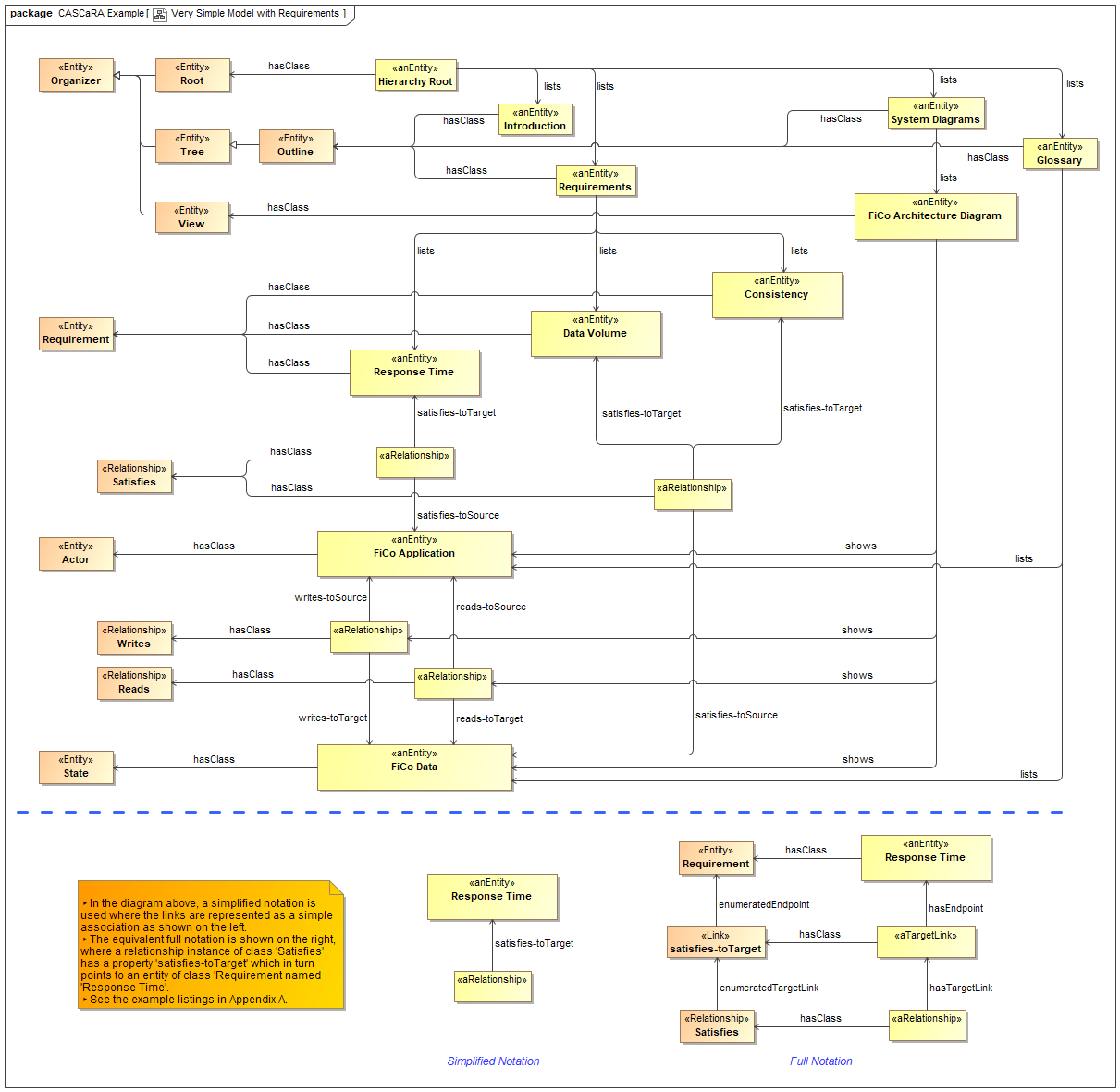
A sample product information graph consisting of
- two system model entities FiCo Application and FiCo Data, where FiCo stands for 'Finance and Controlling';
- two reified system model relationships as instance of Writes and Reads;
- three requirements Response Time, Data Volume and Consistency;
- three reified relationships as instance of Satisfies;
- an Enumeration with title 'Priority-Value' used by the class Requirement and its instances - which is not shown on the diagram;
- none of the properties, classes as well as instances, aren't shown on the diagram, either.
- a diagram showing the two model entities and two model relationships;
- a Hierarchy Root as origin of an outline consisting of four folders Introduction, Requirements, System Diagrams and Glossary;
- Folders and diagrams are sub-classes of Organizer, as they are not part of the model itself, but are creating views of that model for a specific target audience and purpose.
Notes:
- This graph uses classes of the CASCaRA Semantic Infrastructure (visible at the left side of the diagram), but for reasons of simplicity not any classes of an ontology. However, any ontology class would be included as subclasses of the Semantic Infrastructure and the product information as instances of those.
Legend:
- The classes of the CASCaRA Semantic Infrastructure are colored in hues of orange.
- The product information, thus the instances constituting the payload are colored in hues of yellow.
- The boxes represent instances of the CASCaRA Metamodel. where the item type is represented as a stereotype.
- The connectors between the boxes named 'hasClass' are Metamodel associations.
- The other connectors in the diagram above the dashed line are a simplified notation as explained below the dashed line.
| Element Type | Diagram |
| Notation | UML Class Diagram |
| CASCaRA Example | contains | ▣ Very Simple Model with Requirements |
| ▣ Very Simple Model with Requirements | shows | ☆ Consistency ☆ Data Volume ☆ FiCo Application ☆ FiCo Architecture Diagram ☆ FiCo Data ☆ Glossary ☆ Hierarchy Root ☆ Introduction ☆ Requirements ☆ Response Time ☆ satisfies-toTarget ☆ System Diagrams ☆ unnamed uml:Class ☆ unnamed uml:Class Actor Organizer Outline Reads Requirement Root Satisfies State Tree View Writes |
▣ Entity with Property
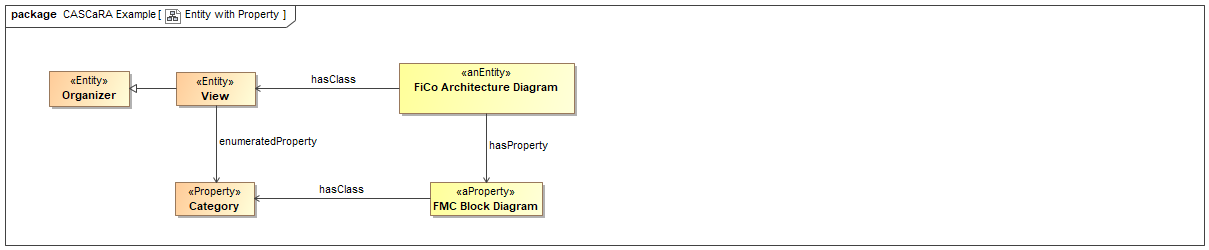
The diagram shows anEntity of class 'View' being a subClass of 'Organizer'. The view 'FiCo Architecture Diagram' has aProperty of class 'Category' with value 'FMC Block Diagram'. See the textual notation in Appendix A or in the GitHub Repository 'CASCaDE Verification and Validation'.
| Element Type | Diagram |
| Notation | UML Class Diagram |
| CASCaRA Example | contains | ▣ Entity with Property |
| ▣ Entity with Property | shows | ☆ Category ☆ FiCo Architecture Diagram ☆ FMC Block Diagram Organizer View |
▣ Entity with Property having Enumerated Values
The diagram shows anEntity of class 'Requirement'. The requirement 'Data Volume' has a property with an enumerated value 'priorityHigh'. See the textual notation in Appendix A or in the GitHub Repository 'CASCaDE Verification and Validation'.
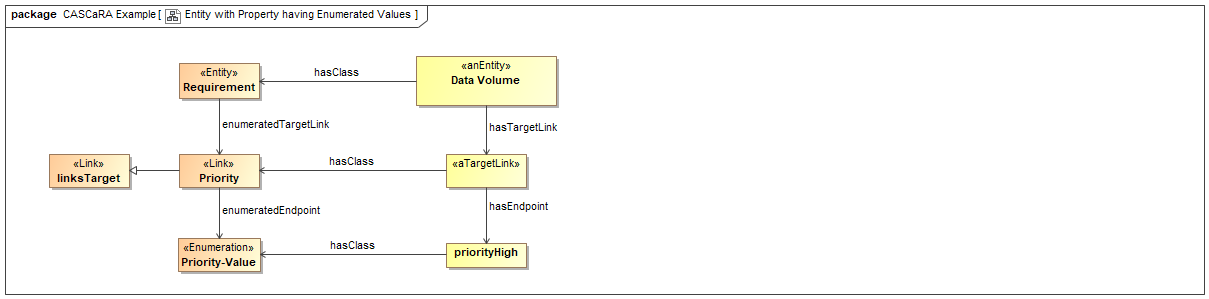
| Element Type | Diagram |
| Notation | UML Class Diagram |
| CASCaRA Example | contains | ▣ Entity with Property having Enumerated Values |
| ▣ Entity with Property having Enumerated Values | shows | ☆ Data Volume ☆ linksTarget ☆ Priority ☆ Priority-Value ☆ priorityHigh ☆ unnamed uml:Class Requirement |
☆ System Diagrams
| Element Type | cas:anEntity |
| CASCaRA Example | contains | ☆ System Diagrams |
| ☆ System Diagrams | hasClass | Outline |
| ☆ Hierarchy Root | lists | ☆ System Diagrams |
| ☆ System Diagrams | lists | ☆ FiCo Architecture Diagram |
| ▣ Very Simple Model with Requirements | shows | ☆ System Diagrams |
☆ FiCo Architecture Diagram
| Element Type | cas:anEntity |
| CASCaRA Example | contains | ☆ FiCo Architecture Diagram |
| ☆ FiCo Architecture Diagram | hasClass | View |
| ☆ FiCo Architecture Diagram | hasProperty | ☆ FMC Block Diagram |
| ☆ System Diagrams | lists | ☆ FiCo Architecture Diagram |
| ▣ Entity with Property ▣ Very Simple Model with Requirements | shows | ☆ FiCo Architecture Diagram |
| ☆ FiCo Architecture Diagram | shows | ☆ FiCo Application ☆ FiCo Data ☆ unnamed uml:Class |
☆ FiCo Application
IT-Application for Finance and Controlling.
| Element Type | cas:anEntity |
| CASCaRA Example | contains | ☆ FiCo Application |
| ☆ FiCo Application | hasClass | Actor |
| ☆ Glossary | lists | ☆ FiCo Application |
| ☆ unnamed uml:Class | reads-toSource | ☆ FiCo Application |
| ☆ unnamed uml:Class | satisfies-toSource | ☆ FiCo Application |
| ☆ FiCo Architecture Diagram ▣ Very Simple Model with Requirements | shows | ☆ FiCo Application |
| ☆ unnamed uml:Class | writes-toSource | ☆ FiCo Application |
☆ FiCo Data
Finance and Controlling Data, such as cost-units per project with budget, accrued cost etc.
| Element Type | cas:anEntity |
| CASCaRA Example | contains | ☆ FiCo Data |
| ☆ FiCo Data | hasClass | State |
| ☆ Glossary | lists | ☆ FiCo Data |
| ☆ unnamed uml:Class | reads-toTarget | ☆ FiCo Data |
| ☆ unnamed uml:Class | satisfies-toSource | ☆ FiCo Data |
| ☆ FiCo Architecture Diagram ▣ Very Simple Model with Requirements | shows | ☆ FiCo Data |
| ☆ unnamed uml:Class | writes-toTarget | ☆ FiCo Data |
☆ Requirements
| Element Type | cas:anEntity |
| CASCaRA Example | contains | ☆ Requirements |
| ☆ Requirements | hasClass | Outline |
| ☆ Hierarchy Root | lists | ☆ Requirements |
| ☆ Requirements | lists | ☆ Consistency ☆ Data Volume ☆ Response Time |
| ▣ Very Simple Model with Requirements | shows | ☆ Requirements |
☆ Data Volume
The data store MUST support a total volume up to 850 GB.
| Element Type | cas:anEntity |
| CASCaRA Example | contains | ☆ Data Volume |
| ☆ Data Volume | hasClass | Requirement |
| ☆ Data Volume | hasTargetLink | ☆ unnamed uml:Class |
| ☆ Requirements | lists | ☆ Data Volume |
| ☆ unnamed uml:Class | satisfies-toTarget | ☆ Data Volume |
| ▣ Entity with Property having Enumerated Values ▣ Very Simple Model with Requirements | shows | ☆ Data Volume |
☆ Consistency
The data store MUST be consistent at all times.
| Element Type | cas:anEntity |
| CASCaRA Example | contains | ☆ Consistency |
| ☆ Consistency | hasClass | Requirement |
| ☆ Requirements | lists | ☆ Consistency |
| ☆ unnamed uml:Class | satisfies-toTarget | ☆ Consistency |
| ▣ Very Simple Model with Requirements | shows | ☆ Consistency |
☆ Response Time
The system SHOULD respond on user queries within 300 ms.
| Element Type | cas:anEntity |
| CASCaRA Example | contains | ☆ Response Time |
| ☆ Response Time | hasClass | Requirement |
| ☆ unnamed uml:Class | hasEndpoint | ☆ Response Time |
| ☆ Requirements | lists | ☆ Response Time |
| ☆ unnamed uml:Class | satisfies-toTarget | ☆ Response Time |
| ▣ Very Simple Model with Requirements | shows | ☆ Response Time |
☆ unnamed uml:Class
| Element Type | cas:aRelationship |
| CASCaRA Example | contains | ☆ unnamed uml:Class |
| ☆ unnamed uml:Class | hasClass | Reads Satisfies Writes |
| ☆ unnamed uml:Class | hasTargetLink | ☆ unnamed uml:Class |
| ☆ unnamed uml:Class | reads-toSource | ☆ FiCo Application |
| ☆ unnamed uml:Class | reads-toTarget | ☆ FiCo Data |
| ☆ unnamed uml:Class | satisfies-toSource | ☆ FiCo Application ☆ FiCo Data |
| ☆ unnamed uml:Class | satisfies-toTarget | ☆ Consistency ☆ Data Volume ☆ Response Time |
| ☆ FiCo Architecture Diagram ▣ Very Simple Model with Requirements | shows | ☆ unnamed uml:Class |
| ☆ unnamed uml:Class | writes-toSource | ☆ FiCo Application |
| ☆ unnamed uml:Class | writes-toTarget | ☆ FiCo Data |
☆ unnamed uml:Class
| Element Type | cas:aTargetLink |
| CASCaRA Example | contains | ☆ unnamed uml:Class |
| ☆ unnamed uml:Class | hasClass | ☆ Priority ☆ satisfies-toTarget |
| ☆ unnamed uml:Class | hasEndpoint | ☆ priorityHigh ☆ Response Time |
| ☆ Data Volume ☆ unnamed uml:Class | hasTargetLink | ☆ unnamed uml:Class |
| ▣ Entity with Property having Enumerated Values ▣ Very Simple Model with Requirements | shows | ☆ unnamed uml:Class |
☆ linksTarget
A Link subclass for use by Relationship to enumerate eligible Entity and/or Relationship classes that can serve as a target.
Example:
- By further specializing this class, a meaningful title can be given to a sourceLink, such as 'employer' in a 'worksFor' relationship being a specialization of Relationship.
| Element Type | cas:Link |
| CASCaRA Example CASCaRA Semantic Infrastructure | contains | ☆ linksTarget |
| Relationship | enumeratedTargetLink | ☆ linksTarget |
| ▣ CASCaRA Semantic Infrastructure Diagram ▣ Entity with Property having Enumerated Values | shows | ☆ linksTarget |
| ☆ Priority | specializes | ☆ linksTarget |
| ☆ linksTarget | specializes | ☆ Link |
Satisfies
| Element Type | Class |
| Satisfies | enumeratedTargetLink | ☆ satisfies-toTarget |
| ☆ unnamed uml:Class | hasClass | Satisfies |
| ▣ Very Simple Model with Requirements | shows | Satisfies |
☆ satisfies-toTarget
| Element Type | cas:Link |
| CASCaRA Example | contains | ☆ satisfies-toTarget |
| ☆ satisfies-toTarget | enumeratedEndpoint | Requirement |
| Satisfies | enumeratedTargetLink | ☆ satisfies-toTarget |
| ☆ unnamed uml:Class | hasClass | ☆ satisfies-toTarget |
| ▣ Very Simple Model with Requirements | shows | ☆ satisfies-toTarget |
Writes
| Element Type | Class |
| ☆ unnamed uml:Class | hasClass | Writes |
| ▣ Very Simple Model with Requirements | shows | Writes |
Reads
| Element Type | Class |
| ☆ unnamed uml:Class | hasClass | Reads |
| ▣ Very Simple Model with Requirements | shows | Reads |
☆ Hierarchy Root
| Element Type | cas:anEntity |
| CASCaRA Example | contains | ☆ Hierarchy Root |
| ☆ Hierarchy Root | hasClass | Root |
| ☆ Hierarchy Root | lists | ☆ Glossary ☆ Introduction ☆ Requirements ☆ System Diagrams |
| ▣ Very Simple Model with Requirements | shows | ☆ Hierarchy Root |
☆ Introduction
| Element Type | cas:anEntity |
| CASCaRA Example | contains | ☆ Introduction |
| ☆ Introduction | hasClass | Outline |
| ☆ Hierarchy Root | lists | ☆ Introduction |
| ▣ Very Simple Model with Requirements | shows | ☆ Introduction |
☆ Glossary
| Element Type | cas:anEntity |
| CASCaRA Example | contains | ☆ Glossary |
| ☆ Glossary | hasClass | Outline |
| ☆ Hierarchy Root | lists | ☆ Glossary |
| ☆ Glossary | lists | ☆ FiCo Application ☆ FiCo Data |
| ▣ Very Simple Model with Requirements | shows | ☆ Glossary |
☆ Category
| Element Type | cas:Property |
| CASCaRA Example | contains | ☆ Category |
| View | enumeratedProperty | ☆ Category |
| ☆ FMC Block Diagram | hasClass | ☆ Category |
| ▣ Entity with Property | shows | ☆ Category |
☆ FMC Block Diagram
| Element Type | cas:aProperty |
| CASCaRA Example | contains | ☆ FMC Block Diagram |
| ☆ FMC Block Diagram | hasClass | ☆ Category |
| ☆ FiCo Architecture Diagram | hasProperty | ☆ FMC Block Diagram |
| ▣ Entity with Property | shows | ☆ FMC Block Diagram |
☆ Priority-Value
| Element Type | cas:Enumeration |
| CASCaRA Example | contains | ☆ Priority-Value |
| ☆ Priority | enumeratedEndpoint | ☆ Priority-Value |
| ☆ priorityHigh | hasClass | ☆ Priority-Value |
| ▣ Entity with Property having Enumerated Values | shows | ☆ Priority-Value |
☆ priorityHigh
| Element Type | Class |
| CASCaRA Example | contains | ☆ priorityHigh |
| ☆ priorityHigh | hasClass | ☆ Priority-Value |
| ☆ unnamed uml:Class | hasEndpoint | ☆ priorityHigh |
| ▣ Entity with Property having Enumerated Values | shows | ☆ priorityHigh |
☆ Priority
| Element Type | cas:Link |
| CASCaRA Example | contains | ☆ Priority |
| ☆ Priority | enumeratedEndpoint | ☆ Priority-Value |
| Requirement | enumeratedTargetLink | ☆ Priority |
| ☆ unnamed uml:Class | hasClass | ☆ Priority |
| ▣ Entity with Property having Enumerated Values | shows | ☆ Priority |
| ☆ Priority | specializes | ☆ linksTarget |
Model Elements (Glossary)
| Element Type | Model Elements (Glossary) |
Actor
An 'Actor' is a fundamental model element type representing an active entity, be it an activity, a process step, a function, a system component or a role.
| Element Type | Class |
| Actor | enumeratedTargetLink | ☆ hasQuantityValue |
| ☆ FiCo Application | hasClass | Actor |
| ▣ CASCaRA Semantic Infrastructure Diagram ▣ Very Simple Model with Requirements | shows | Actor |
| Actor | specializes | Entity |
☆ aLink
Is a technical super-class for link instances.
Details:
- The class is abstract.
- A list of enumerated endpoints (references) per link instance is possible.
- If the class is set to versionAware, all pointers to an endpoint must contain both identifier and revision.
| Element Type | Class |
| CASCaRA Metamodel | contains | ☆ aLink |
| ☆ aLink | hasClass | ☆ Link |
| ☆ aLink | hasEndpoint | ☆ anElement |
| ▣ CASCaRA Metamodel Diagram | shows | ☆ aLink |
| ☆ aSourceLink ☆ aTargetLink | specializes | ☆ aLink |
| ☆ aLink | specializes | ☆ Item |
☆ anElement
A technical superclass of anEntity and aRelationship.
Details:
- The class is abstract.
- All attributes and associations are inherited by its sub-classes.
- Sub-classes may have individual revisions with revision id, modification date and creator. The prior revision id is memorized to support change history and branching. In case of a merge, there are two prior revisions.
| Element Type | Class |
| CASCaRA Metamodel | contains | ☆ anElement |
| ☆ anElement | has part | ○ creator ○ modified ○ priorRevision ○ revision |
| ☆ aLink | hasEndpoint | ☆ anElement |
| ☆ anElement | hasProperty | ☆ aProperty |
| ▣ CASCaRA Metamodel Diagram | shows | ☆ anElement |
| ☆ anEntity ☆ aRelationship | specializes | ☆ anElement |
| ☆ anElement | specializes | ☆ Identifiable |
☆ anEntity
Is used for instances of model-elements such as a system component or a requirement. Is 'payload' having a clear meaning through the respective Entity class.
Details:
- An entity must have either a title or a description - or both. This allows to compose documents including text paragraphs without title.
- The entity's class enumerates the classes of properties it may have.
| Element Type | Class |
| CASCaRA Metamodel | contains | ☆ anEntity |
| ☆ anEntity | hasClass | ☆ Entity |
| ☆ anEntity | hasTargetLink | ☆ aTargetLink |
| ▣ CASCaRA Metamodel Diagram | shows | ☆ anEntity |
| ☆ aPackage | specializes | ☆ anEntity |
| ☆ anEntity | specializes | ☆ anElement |
☆ aPackage
A container for any selection of metamodel items. Standardized and addressable classes can be excluded from aPackage. Thus aPackage contains specific classes (from organization or project ontologies) plus the instances of interest.
Details:
- The class of aPackage is formally Entity, but should be a subclass of Organizer (see CASCaRA Semantic Infrastructure).
- aPackage can be nested.
- Additional properties such as license, contributor or import nested packages are enumerated in the class of Package.
| Element Type | Class |
| ☆ aPackage | composes | ☆ aPackage |
| CASCaRA Metamodel | contains | ☆ aPackage |
| ☆ aPackage | graph | ☆ Identifiable |
| ☆ aPackage | has part | ○ context |
| ▣ CASCaRA Metamodel Diagram | shows | ☆ aPackage |
| ☆ aPackage | specializes | ☆ anEntity |
☆ aProperty
Each property belongs to a single anEntity, aRelationship or aPackage. A property has no identifier, thus a property update results in a new revision of the item to which it belongs. Is 'payload' having a clear meaning, datatype and range through the respective Property class.
Details:
- A property may be required or not depending on the attributes minCount and maxCount of its class, but an existing property must have a value.
- A property may be composed of multiple properties to form a structured data set according to its Property class.
| Element Type | Class |
| ☆ aProperty | composes | ☆ aProperty |
| CASCaRA Metamodel | contains | ☆ aProperty |
| ☆ aProperty | has part | ○ value |
| ☆ aProperty | hasClass | ☆ Property |
| ☆ anElement | hasProperty | ☆ aProperty |
| ▣ CASCaRA Metamodel Diagram | shows | ☆ aProperty |
| ☆ aProperty | specializes | ☆ Item |
☆ aRelationship
Is used for relations between entities, such as a 'system component satisfies a requirement'. All relationships are bilateral and directed. Is 'payload' having a clear meaning through the respective Relationship class.
Details:
- This is a reified graph edge and must have exactly one source and target entity each. The source must be an entity or relationship with a class defined by an eligible source class of its Relationship. The same applies for the target.
- Even though a relationship instance may have an individual title, it is advised to omit it and assume its class' title when needed to assure that relationships of the same class are named equally.
- The relationship's class enumerates the classes of properties it may have.
| Element Type | Class |
| CASCaRA Metamodel | contains | ☆ aRelationship |
| ☆ aRelationship | hasClass | ☆ Relationship |
| ☆ aRelationship | hasSourceLink | ☆ aSourceLink |
| ☆ aRelationship | hasTargetLink | ☆ aTargetLink |
| ▣ CASCaRA Metamodel Diagram | shows | ☆ aRelationship |
| ☆ aRelationship | specializes | ☆ anElement |
☆ aSourceLink
A link instance serving as source for a reified relationship.
From a semantic point of view, there is no need to make a distinction between aSourceLink and aTargetLink at the metamodel level. The distinction can be done and is made at ontology level in the CASCaRA Semantic Infrastructure. However it is much easier to check the pattern/schema/shape and to ingest data, if the itemType is explicit.
Details:
- aSourceLink may be required or not depending on the attributes minCount and maxCount of its class, but an existing one must have a value.
Example:
- A single 'satisfies' relationship can relate one or many function instances to a requirement instance.
| Element Type | Class |
| CASCaRA Metamodel | contains | ☆ aSourceLink |
| ☆ aRelationship | hasSourceLink | ☆ aSourceLink |
| ▣ CASCaRA Metamodel Diagram | shows | ☆ aSourceLink |
| ☆ aSourceLink | specializes | ☆ aLink |
☆ aTargetLink
A link instance pointing to the target of a reified aRelationship or to one or more targets of anEntity.
From a semantic point of view, there is no need to make a distinction between aSourceLink and aTargetLink at the metamodel level. The distinction can be done and is made at ontology level in the CASCaRA Semantic Infrastructure. However it is much easier to check the pattern/schema/shape and to ingest data, if the itemType is explicit.
Details:
- aTargetLink may be required or not depending on the attributes minCount and maxCount of its class, but an existing one must have a value.
Example:
- A 'satisfies' relationship can relate a function instance to one or multiple requirement instances (targets).
- An organizer (see CASCaRA Semantic Infrastructure) such as a chapter title (folder) in an outline can point to one or more contained items, be it anEntity or aRelationship or other.
- anEntity, aRelationship or aPackage may point to value of an Enumeration.
| Element Type | Class |
| CASCaRA Metamodel | contains | ☆ aTargetLink |
| ☆ anEntity ☆ aRelationship | hasTargetLink | ☆ aTargetLink |
| ▣ CASCaRA Metamodel Diagram | shows | ☆ aTargetLink |
| ☆ aTargetLink | specializes | ☆ aLink |
☆ Category
| Element Type | cas:Property |
| CASCaRA Example | contains | ☆ Category |
| View | enumeratedProperty | ☆ Category |
| ☆ FMC Block Diagram | hasClass | ☆ Category |
| ▣ Entity with Property | shows | ☆ Category |
Collection
A 'Collection' is a logical (often conceptual) group of resources linked with a relationship (tbd). It corresponds to a 'Group' in BPMN or a 'Grouping' in ArchiMate.
- BPMN: An arbitrary set of objects can be defined as a Group to show that they logically belong together. Source: BPMN Tutorial.
- ArchiMate: The grouping element aggregates or composes concepts that belong together based on some common characteristic. Source: ArchiMate® 3.2 Specification.
| Element Type | Class |
| ▣ CASCaRA Semantic Infrastructure Diagram | shows | Collection |
| Collection | specializes | Entity |
☆ Configurable
Besides native properties such as title and description, Elements can have configurable properties and links. Those configurable properties and links support a dynamic data model, so that the ontology can evolve over time without software change. Sufficient detail such as data type and range can be provided to build dynamic forms, for example. It is in fact the core feature to separate CASCaRA syntax and semantics.
Details:
- This class is abstract
| Element Type | Class |
| CASCaRA Metamodel | contains | ☆ Configurable |
| ☆ Configurable | has part | ○ defaultValue ○ globalTitle ○ maxCount ○ minCount ○ readOnly |
| ▣ CASCaRA Metamodel Diagram | shows | ☆ Configurable |
| ☆ Link ☆ Property | specializes | ☆ Configurable |
| ☆ Configurable | specializes | ☆ Identifiable |
☆ Consistency
The data store MUST be consistent at all times.
| Element Type | cas:anEntity |
| CASCaRA Example | contains | ☆ Consistency |
| ☆ Consistency | hasClass | Requirement |
| ☆ Requirements | lists | ☆ Consistency |
| ☆ unnamed uml:Class | satisfies-toTarget | ☆ Consistency |
| ▣ Very Simple Model with Requirements | shows | ☆ Consistency |
○ context
A list of IRIs per namespace abbreviation. Used as sequence of @prefix in RDF/Turtle, sequence of xmlns: in XML and @context in JSON-LD.
| Element Type | uml:Property |
| ☆ aPackage | has part | ○ context |
| ▣ CASCaRA Metamodel Diagram | shows | ○ context |
○ creator
The person committing the last change. Is often an e-mail address.
| Element Type | uml:Property |
| ☆ anElement | has part | ○ creator |
| ▣ CASCaRA Metamodel Diagram | shows | ○ creator |
☆ Data Volume
The data store MUST support a total volume up to 850 GB.
| Element Type | cas:anEntity |
| CASCaRA Example | contains | ☆ Data Volume |
| ☆ Data Volume | hasClass | Requirement |
| ☆ Data Volume | hasTargetLink | ☆ unnamed uml:Class |
| ☆ Requirements | lists | ☆ Data Volume |
| ☆ unnamed uml:Class | satisfies-toTarget | ☆ Data Volume |
| ▣ Entity with Property having Enumerated Values ▣ Very Simple Model with Requirements | shows | ☆ Data Volume |
○ datatype
One of the xs: data types. Shall be anyURI.
| Element Type | uml:Property |
| ☆ Enumeration ☆ Property | has part | ○ datatype |
| ▣ CASCaRA Metamodel Diagram | shows | ○ datatype |
○ defaultValue
Optional default value(s) in case a modelElement's property does not have an individual value when instantiated. It may be changed later on and must follow the definitions of the PropertyClass resp. LinkClass at all times, of course.
Here, the attribute is named 'defaultValue' for clarity and may just be called 'value' in an implementation, as all restrictions and operations of a property's value apply.
| Element Type | uml:Property |
| ☆ Configurable ☆ Link | has part | ○ defaultValue |
| ▣ CASCaRA Metamodel Diagram | shows | ○ defaultValue |
○ definition
A multiLanguageText mandatory for all classes. Maps to skos:definition.
| Element Type | uml:Property |
| ☆ Element | has part | ○ definition |
| ▣ CASCaRA Metamodel Diagram | shows | ○ definition |
☆ depicts
A Link class for use by View to enumerate eligible Entity and/or Relationship classes that can own a view (e.g. a state diagram describing the behavior of a component where the latter owns the depicting view).
| Element Type | cas:Link |
| CASCaRA Semantic Infrastructure | contains | ☆ depicts |
| ☆ depicts | enumeratedEndpoint | Entity |
| View | enumeratedTargetLink | ☆ depicts |
| ▣ CASCaRA Semantic Infrastructure Diagram | shows | ☆ depicts |
| ☆ depicts | specializes | ☆ Link |
○ description
A multiLanguageText. Maps to dcterms:description.
Details:
- Here a multiplicity [0..1] is given, but in fact that depends on the itemType.
- For all classes (Enumeration, Property, Link, Entity and Relationship), a title is mandatory.
- In case of anEntity at least one of title or description is required, because it must be possible to represent a text paragraph as anEntity, which simply does not have a title.
- In case of aRelationship both title and description are optional. If missing the title and/or description of the respective Relationship class applies. This avoids lots of repetition in real-world data-sets.
- The same applies for aProperty, aSourceLink and aTargetLink; both title and description are optional.
| Element Type | uml:Property |
| ☆ Identifiable | has part | ○ description |
| ▣ CASCaRA Metamodel Diagram | shows | ○ description |
☆ Element
A technical super-class of Entity (class of entities) and Relationship (class of relationships).
Details:
- The class is abstract.
- All attributes and associations are inherited by its technical sub-classes Entity and Relationship.
- The globalTitle of the Elements is used to integrate the instances of a partial graphs to an overarching CASCaRA graph.
| Element Type | Class |
| CASCaRA Metamodel | contains | ☆ Element |
| ☆ Link | enumeratedEndpoint | ☆ Element |
| ☆ Element | enumeratedProperty | ☆ Property |
| ☆ Element | has part | ○ definition ○ globalTitle ○ icon |
| ▣ CASCaRA Metamodel Diagram | shows | ☆ Element |
| ☆ Entity ☆ Enumeration ☆ Relationship | specializes | ☆ Element |
| ☆ Element | specializes | ☆ Identifiable |
☆ Entity
Entity is a class of model elements, such as a system component or a requirement. An Entity is an owl:Class.
Details:
- Entity should have a title (name) and may have a description (definition).
- Entity may specify (configure) zero to many classes of properties its instances may have.
- The definitions of the entity together with those of the properties may be used to build user dialogs with input verification as well as to check its instances whether all property values have a correct type and value range as well as whether all required ones are present.
| Element Type | Class |
| CASCaRA Metamodel | contains | ☆ Entity |
| ☆ Entity | enumeratedTargetLink | ☆ Link |
| ☆ anEntity | hasClass | ☆ Entity |
| ▣ CASCaRA Metamodel Diagram | shows | ☆ Entity |
| ☆ Entity | specializes | ☆ Element ☆ Entity |
Entity
The semantic foundation for all Entity (class) definitions. Is an owl:Class.
| Element Type | Class |
| ☆ depicts ☆ lists ☆ shows | enumeratedEndpoint | Entity |
| Entity | enumeratedTargetLink | ☆ linksEnumeratedValue |
| ▣ CASCaRA Semantic Infrastructure Diagram | shows | Entity |
| Actor Collection Event Feature Organizer QuantityValue Requirement State | specializes | Entity |
○ enumeratedValue
A defined value of an Enumeration.
Details:
- It must have the datatype specified by its parent.
- If the datatype is string, the value is a language string consisting of value and IETF language tag ('multiLangueText').
- Otherwise the value is a simple value.
- Values of all datatypes are represented as a string in all data formats, even JSON and JSON-LD.
| Element Type | uml:Property |
| ☆ Enumeration | has part | ○ enumeratedValue |
| ▣ CASCaRA Metamodel Diagram | shows | ○ enumeratedValue |
☆ Enumeration
A class defining a set of enumerated values for use by any set of instances, where each value has an id and a value, either multiLanguageText in case of datatype xs:string or a simple value for all other datatypes.
A corresponding Link class must be defined with an enumeratedEndpoint to this enumeration class. An instance then has zero to many (0..n) aTargetLinks pointing to a value of the enumeration with hasTargetLink (not yet shown in the model diagram - this design is somewhat cumbersome and needs review). The required number of values is defined by minCount and maxCount of the Link class.
| Element Type | Class |
| CASCaRA Metamodel | contains | ☆ Enumeration |
| ☆ Enumeration | has part | ○ datatype ○ enumeratedValue |
| ▣ CASCaRA Metamodel Diagram | shows | ☆ Enumeration |
| ☆ Enumeration | specializes | ☆ Element ☆ Enumeration |
☆ Enumeration
The semantic foundation for all Enumeration (class) definitions. Is an owl:Class. Has a finite list of values for Properties.
| Element Type | cas:Enumeration |
| CASCaRA Semantic Infrastructure | contains | ☆ Enumeration |
| ▣ CASCaRA Semantic Infrastructure Diagram | shows | ☆ Enumeration |
Event
An 'Event' is a fundamental model element type representing a time reference, a change in condition/value or more generally a synchronization primitive.
| Element Type | Class |
| Event | enumeratedTargetLink | ☆ hasQuantityValue |
| ▣ CASCaRA Semantic Infrastructure Diagram | shows | Event |
| Event | specializes | Entity |
Feature
A 'Feature' is an intentional distinguishing characteristic of a system, often a unique selling proposition.
| Element Type | Class |
| Feature | enumeratedTargetLink | ☆ hasQuantityValue |
| ▣ CASCaRA Semantic Infrastructure Diagram | shows | Feature |
| Feature | specializes | Entity |
☆ FiCo Application
IT-Application for Finance and Controlling.
| Element Type | cas:anEntity |
| CASCaRA Example | contains | ☆ FiCo Application |
| ☆ FiCo Application | hasClass | Actor |
| ☆ Glossary | lists | ☆ FiCo Application |
| ☆ unnamed uml:Class | reads-toSource | ☆ FiCo Application |
| ☆ unnamed uml:Class | satisfies-toSource | ☆ FiCo Application |
| ☆ FiCo Architecture Diagram ▣ Very Simple Model with Requirements | shows | ☆ FiCo Application |
| ☆ unnamed uml:Class | writes-toSource | ☆ FiCo Application |
☆ FiCo Architecture Diagram
| Element Type | cas:anEntity |
| CASCaRA Example | contains | ☆ FiCo Architecture Diagram |
| ☆ FiCo Architecture Diagram | hasClass | View |
| ☆ FiCo Architecture Diagram | hasProperty | ☆ FMC Block Diagram |
| ☆ System Diagrams | lists | ☆ FiCo Architecture Diagram |
| ▣ Entity with Property ▣ Very Simple Model with Requirements | shows | ☆ FiCo Architecture Diagram |
| ☆ FiCo Architecture Diagram | shows | ☆ FiCo Application ☆ FiCo Data ☆ unnamed uml:Class |
☆ FiCo Data
Finance and Controlling Data, such as cost-units per project with budget, accrued cost etc.
| Element Type | cas:anEntity |
| CASCaRA Example | contains | ☆ FiCo Data |
| ☆ FiCo Data | hasClass | State |
| ☆ Glossary | lists | ☆ FiCo Data |
| ☆ unnamed uml:Class | reads-toTarget | ☆ FiCo Data |
| ☆ unnamed uml:Class | satisfies-toSource | ☆ FiCo Data |
| ☆ FiCo Architecture Diagram ▣ Very Simple Model with Requirements | shows | ☆ FiCo Data |
| ☆ unnamed uml:Class | writes-toTarget | ☆ FiCo Data |
☆ FMC Block Diagram
| Element Type | cas:aProperty |
| CASCaRA Example | contains | ☆ FMC Block Diagram |
| ☆ FMC Block Diagram | hasClass | ☆ Category |
| ☆ FiCo Architecture Diagram | hasProperty | ☆ FMC Block Diagram |
| ▣ Entity with Property | shows | ☆ FMC Block Diagram |
○ globalReversed
If set, the instances of the Relationship are interpreted in reverse direction when evaluated in the global graph.
Example:
- If the ontology defines a term 'satisfies', an incoming relationship named 'satisfied-by' is reversed and the globalTitle is set to 'satisfies' and globalReversed is set to 'true'.
| Element Type | uml:Property |
| ☆ Relationship | has part | ○ globalReversed |
| ▣ CASCaRA Metamodel Diagram | shows | ○ globalReversed |
○ globalTitle
The title assigned by matching the title with the terms of the ontology by the 'globalize' operation.
| Element Type | uml:Property |
| ☆ Configurable ☆ Element | has part | ○ globalTitle |
| ▣ CASCaRA Metamodel Diagram | shows | ○ globalTitle |
☆ Glossary
| Element Type | cas:anEntity |
| CASCaRA Example | contains | ☆ Glossary |
| ☆ Glossary | hasClass | Outline |
| ☆ Hierarchy Root | lists | ☆ Glossary |
| ☆ Glossary | lists | ☆ FiCo Application ☆ FiCo Data |
| ▣ Very Simple Model with Requirements | shows | ☆ Glossary |
☆ hasQuantityValue
| Element Type | cas:Link |
| CASCaRA Semantic Infrastructure | contains | ☆ hasQuantityValue |
| ☆ hasQuantityValue | enumeratedEndpoint | QuantityValue |
| Actor Event Feature Requirement State | enumeratedTargetLink | ☆ hasQuantityValue |
| ▣ CASCaRA Semantic Infrastructure Diagram | shows | ☆ hasQuantityValue |
| ☆ hasQuantityValue | specializes | ☆ Link |
☆ Hierarchy Root
| Element Type | cas:anEntity |
| CASCaRA Example | contains | ☆ Hierarchy Root |
| ☆ Hierarchy Root | hasClass | Root |
| ☆ Hierarchy Root | lists | ☆ Glossary ☆ Introduction ☆ Requirements ☆ System Diagrams |
| ▣ Very Simple Model with Requirements | shows | ☆ Hierarchy Root |
○ icon
An icon defined with a class can be used to decorate the instances.
Example:
- Folders as sub-class of Organizer and thus Entity may specify a UTF-8 character 🗀 for use by folders grouping certain model-elements.
- A data-URL of an icon is also permitted.
| Element Type | uml:Property |
| ☆ Element | has part | ○ icon |
| ▣ CASCaRA Metamodel Diagram | shows | ○ icon |
○ id
A globally unique identifier, either a fully qualified URI or a name with namespace standing for an URI, see aPackage context.
| Element Type | uml:Property |
| ☆ Identifiable | has part | ○ id |
| ▣ CASCaRA Metamodel Diagram | shows | ○ id |
☆ Identifiable
All technical sub-classes of this class are identifiable, means they have an identifier, a title (name) and optionally a description.
Details:
- The class is abstract.
- All attributes are inherited by its subclasses.
- All class level items in the upper part of the diagram are commonly released and made available with an URL path including the revision. Hence, multiple revisions of the class set may exist in parallel.
- All instance level items in the lower part of the diagram may have individual revisions with their respective revision, modification date and creator. The prior revision identifier is memorized to support change history and branching. In case of a merge, there are two prior revisions.
| Element Type | Class |
| CASCaRA Metamodel | contains | ☆ Identifiable |
| ☆ aPackage | graph | ☆ Identifiable |
| ☆ Identifiable | has part | ○ description ○ id ○ title |
| ▣ CASCaRA Metamodel Diagram | shows | ☆ Identifiable |
| ☆ anElement ☆ Configurable ☆ Element | specializes | ☆ Identifiable |
| ☆ Identifiable | specializes | ☆ Item |
☆ Introduction
| Element Type | cas:anEntity |
| CASCaRA Example | contains | ☆ Introduction |
| ☆ Introduction | hasClass | Outline |
| ☆ Hierarchy Root | lists | ☆ Introduction |
| ▣ Very Simple Model with Requirements | shows | ☆ Introduction |
☆ Item
The technical super-class of all CASCaRA metamodel items specifying the type of item to allow for simple schema checking and transformation.
Details:
- The class is abstract.
| Element Type | Class |
| CASCaRA Metamodel | contains | ☆ Item |
| ☆ Item | has part | ○ itemType |
| ▣ CASCaRA Metamodel Diagram | shows | ☆ Item |
| ☆ aLink ☆ aProperty ☆ Identifiable | specializes | ☆ Item |
○ itemType
Classifies classes and individuals (instances) in terms of this metamodel. It must be made explicit in all representations without native reasoner, such as in object-oriented programming, JSON, JSON-LD and XML. It can be omitted in RDF/OWL, as at the top of the class hierarchy there shall be a class corresponding to the metamodel itemType (see CASCARA Semantic Infrastructure and the itemType can be derived with a standard OWL reasoner.
Details:
- Here it is modeled as a string, but in fact it is an enumerated value from all concrete metamodel items (represented as UML classes), thus [Enumeration, Link, Property, Entity, Relationship, aPackage, aSourceLink, aTargetLink, aProperty, anEntity, aRelationship].
| Element Type | uml:Property |
| ☆ Item | has part | ○ itemType |
| ▣ CASCaRA Metamodel Diagram | shows | ○ itemType |
☆ Link
A Link is an identifiable link class. A Link is an owl:ObjectProperty.
Example:
- An Organizer (semantic sub-class of Entity) may list Model-Elements (another semantic sub-class of Entity) to provide a document outline.
- As such the Link class lists is specified as enumeratedTargetLink by Organizer.
| Element Type | Class |
| CASCaRA Metamodel | contains | ☆ Link |
| ☆ Link | enumeratedEndpoint | ☆ Element |
| ☆ Relationship | enumeratedSourceLink | ☆ Link |
| ☆ Entity ☆ Relationship | enumeratedTargetLink | ☆ Link |
| ☆ Link | has part | ○ defaultValue ○ maxCount ○ minCount ○ readOnly ○ revisionAware |
| ☆ aLink | hasClass | ☆ Link |
| ▣ CASCaRA Metamodel Diagram | shows | ☆ Link |
| ☆ Link | specializes | ☆ Configurable ☆ Link |
☆ Link
The semantic foundation for all Link (class) definitions. Is an owl:ObjectProperty.
| Element Type | cas:Link |
| CASCaRA Semantic Infrastructure | contains | ☆ Link |
| ▣ CASCaRA Semantic Infrastructure Diagram | shows | ☆ Link |
| ☆ depicts ☆ hasQuantityValue ☆ linksEnumeratedValue ☆ linksSource ☆ linksTarget ☆ lists ☆ shows | specializes | ☆ Link |
☆ linksEnumeratedValue
A Link subclass for use by an Entity or Relationship to enumerate eligible Enumeration classes that can serve as a target.
Example:
- A Requirement specifies a priority, where the priority values are defined in an Enumeration class and the link to use as linksEnumeration.
- A meaningful link name such as 'has Priority' can be created through a subclass of linksEnumeration.
| Element Type | cas:Link |
| CASCaRA Semantic Infrastructure | contains | ☆ linksEnumeratedValue |
| Entity Relationship | enumeratedTargetLink | ☆ linksEnumeratedValue |
| ▣ CASCaRA Semantic Infrastructure Diagram | shows | ☆ linksEnumeratedValue |
| ☆ linksEnumeratedValue | specializes | ☆ Link |
☆ linksSource
A Link subclass for use by Relationship to enumerate eligible Entity and/or Relationship classes that can serve as a source.
Example:
- By further specializing this class, a speaking title can be given to a sourceLink, such as 'employee' in a 'worksFor' relationship being a specialization of Relationship.
| Element Type | cas:Link |
| CASCaRA Semantic Infrastructure | contains | ☆ linksSource |
| Relationship | enumeratedSourceLink | ☆ linksSource |
| ▣ CASCaRA Semantic Infrastructure Diagram | shows | ☆ linksSource |
| ☆ linksSource | specializes | ☆ Link |
☆ linksTarget
A Link subclass for use by Relationship to enumerate eligible Entity and/or Relationship classes that can serve as a target.
Example:
- By further specializing this class, a meaningful title can be given to a sourceLink, such as 'employer' in a 'worksFor' relationship being a specialization of Relationship.
| Element Type | cas:Link |
| CASCaRA Example CASCaRA Semantic Infrastructure | contains | ☆ linksTarget |
| Relationship | enumeratedTargetLink | ☆ linksTarget |
| ▣ CASCaRA Semantic Infrastructure Diagram ▣ Entity with Property having Enumerated Values | shows | ☆ linksTarget |
| ☆ Priority | specializes | ☆ linksTarget |
| ☆ linksTarget | specializes | ☆ Link |
☆ lists
A Link class for use by Outline to enumerate eligible Entity and/or Relationship classes.
| Element Type | cas:Link |
| CASCaRA Semantic Infrastructure | contains | ☆ lists |
| ☆ lists | enumeratedEndpoint | Entity Relationship |
| Outline | enumeratedTargetLink | ☆ lists |
| ▣ CASCaRA Semantic Infrastructure Diagram | shows | ☆ lists |
| ☆ lists | specializes | ☆ Link |
○ maxCount
An instance must have at most this number of properties of this class. Is unbounded (infinite) by default. This applies to both instances of a Property class and a Link class.
For example, if a property class 'Priority' has a maxCount=1 and a requirement class specifies an enumeratedProperty 'Priority', a requirement instance must have no more than one property of class Priority (with a value).
| Element Type | uml:Property |
| ☆ Configurable ☆ Link | has part | ○ maxCount |
| ▣ CASCaRA Metamodel Diagram | shows | ○ maxCount |
○ maxInclusive
The maximum value a property of this type may have. May be applied only for numeric datatypes. It the intrinsic maximum value of the datatype by default.
| Element Type | uml:Property |
| ☆ Property | has part | ○ maxInclusive |
| ▣ CASCaRA Metamodel Diagram | shows | ○ maxInclusive |
○ maxLength
Maximum length of a property value with datatype 'xs:string'. Is not allowed with any other datatype.
| Element Type | uml:Property |
| ☆ Property | has part | ○ maxLength |
| ▣ CASCaRA Metamodel Diagram | shows | ○ maxLength |
○ minCount
An instance must have at least this number of properties of this class. Is '0' by default. This applies to both instances of a Property class and a Link class.
For example, if a property class 'Priority' has a minCount=1 and a requirement class specifies an enumeratedProperty 'Priority', a requirement instance must have at least one property of class Priority (with a value).
| Element Type | uml:Property |
| ☆ Configurable ☆ Link | has part | ○ minCount |
| ▣ CASCaRA Metamodel Diagram | shows | ○ minCount |
○ minInclusive
The minimum value a property of this type may have. May be applied only for numeric datatypes. It the intrinsic minimum value of the datatype by default.
| Element Type | uml:Property |
| ☆ Property | has part | ○ minInclusive |
| ▣ CASCaRA Metamodel Diagram | shows | ○ minInclusive |
○ modified
A ISO-8601 DateTime value recording the point in time of the last change.
| Element Type | uml:Property |
| ☆ anElement | has part | ○ modified |
| ▣ CASCaRA Metamodel Diagram | shows | ○ modified |
Organizer
An Organizer is about presenting genuine a selection of model-elements for a given target group of users, for example a document outline, a table or a diagram.
| Element Type | Class |
| ▣ CASCaRA Semantic Infrastructure Diagram ▣ Entity with Property ▣ Very Simple Model with Requirements | shows | Organizer |
| Package Root Table Tree View | specializes | Organizer |
| Organizer | specializes | Entity |
Outline
A tree (hierarchical arrangement) of references to graph nodes (vertices) to create a reading sequence. Graph nodes include Entity and Relationship. Outline is used at any level of the tree like a directory folder or universally for section, chapter and paragraph of a document.
| Element Type | Class |
| Outline | enumeratedTargetLink | ☆ lists |
| ☆ Glossary ☆ Introduction ☆ Requirements ☆ System Diagrams | hasClass | Outline |
| ▣ CASCaRA Semantic Infrastructure Diagram ▣ Very Simple Model with Requirements | shows | Outline |
| Outline | specializes | Tree |
Package
A Package contains a given selection of CASCaRA items (classes and instances) for a given purpose, such as a component specification for review or in a customer-supplier relationship.
| Element Type | Class |
| ▣ CASCaRA Semantic Infrastructure Diagram | shows | Package |
| Package | specializes | Organizer |
○ pattern
A Regular Expression that must evaluate successfully with the property value. Can also be used to limit the number of decimals of a number, as there is no restriction like xs:fractionDigits in SHACL.
| Element Type | uml:Property |
| ☆ Property | has part | ○ pattern |
| ▣ CASCaRA Metamodel Diagram | shows | ○ pattern |
☆ Priority
| Element Type | cas:Link |
| CASCaRA Example | contains | ☆ Priority |
| ☆ Priority | enumeratedEndpoint | ☆ Priority-Value |
| Requirement | enumeratedTargetLink | ☆ Priority |
| ☆ unnamed uml:Class | hasClass | ☆ Priority |
| ▣ Entity with Property having Enumerated Values | shows | ☆ Priority |
| ☆ Priority | specializes | ☆ linksTarget |
☆ Priority-Value
| Element Type | cas:Enumeration |
| CASCaRA Example | contains | ☆ Priority-Value |
| ☆ Priority | enumeratedEndpoint | ☆ Priority-Value |
| ☆ priorityHigh | hasClass | ☆ Priority-Value |
| ▣ Entity with Property having Enumerated Values | shows | ☆ Priority-Value |
☆ priorityHigh
| Element Type | Class |
| CASCaRA Example | contains | ☆ priorityHigh |
| ☆ priorityHigh | hasClass | ☆ Priority-Value |
| ☆ unnamed uml:Class | hasEndpoint | ☆ priorityHigh |
| ▣ Entity with Property having Enumerated Values | shows | ☆ priorityHigh |
○ priorRevision
Links to the previous revisions of an entity or relationship instance. It is a list with
- zero elements, if it is the first revision,
- one element for a subsequent revision or
- two elements when two branches are merged.
| Element Type | uml:Property |
| ☆ anElement | has part | ○ priorRevision |
| ▣ CASCaRA Metamodel Diagram | shows | ○ priorRevision |
☆ Property
Every class Entity and Relationship can have an individual set of configurable properties, each of which is uniquely defined by datatype and range. A Property is an owl:ObjectProperty when enumeratedValues are defined and is an owl:DatatypeProperty otherwise.
Example: A requirement might have a list with three properties, such as
- Title with data type „String of max. length 96“,
- Description with data type „String“ wíthout length restriction and
- Priority with data type „String with a single choice of ['high', 'medium', 'low']“.
Details:
- Property class must have a title and may have a description named.
- Property class may define a minimum and maximum count of values.
- Property class must define a datatype and may restrict its range by minInclusive, maxInclusive or or a pattern defined by Regular Expression.
- Property class may define a set of enumerated values which must of course satisfy its own data type and range
- A property class may define a default value which must of course satisfy its own data type and range.
- Property class may be composed of multiple property classes to form a structured data type (xs:complexType). The structure must be a tree, thus without cyclic dependency.
| Element Type | Class |
| ☆ Property | composes | ☆ Property |
| CASCaRA Metamodel | contains | ☆ Property |
| ☆ Element | enumeratedProperty | ☆ Property |
| ☆ Property | has part | ○ datatype ○ maxInclusive ○ maxLength ○ minInclusive ○ pattern |
| ☆ aProperty | hasClass | ☆ Property |
| ▣ CASCaRA Metamodel Diagram | shows | ☆ Property |
| ☆ Property | specializes | ☆ Configurable ☆ Property |
☆ Property
The semantic foundation for all Property (class) definitions. Is an owl:DatatypeProperty.
| Element Type | cas:Property |
| CASCaRA Semantic Infrastructure | contains | ☆ Property |
| ▣ CASCaRA Semantic Infrastructure Diagram | shows | ☆ Property |
QuantityValue
A dimensioned quantity with two properties, a 'quantity' (a numeric value) and a 'unit' of measurement.
| Element Type | Class |
| ☆ hasQuantityValue | enumeratedEndpoint | QuantityValue |
| ▣ CASCaRA Semantic Infrastructure Diagram | shows | QuantityValue |
| QuantityValue | specializes | Entity |
○ readOnly
The link value of an instance may not be updated or deleted, once assigned.
| Element Type | uml:Property |
| ☆ Configurable ☆ Link | has part | ○ readOnly |
| ▣ CASCaRA Metamodel Diagram | shows | ○ readOnly |
Reads
| Element Type | Class |
| ☆ unnamed uml:Class | hasClass | Reads |
| ▣ Very Simple Model with Requirements | shows | Reads |
☆ Relationship
Relationship is a class of relationships between two entities to allow assertions such as 'a system component satisfies a requirement'. All relationships are bilateral and directed. This allows for statements according to propositional logic. They can be easily mapped to many technologies such as RDF or even ReqIF. Being reified, a Relationship is an owl:Class.
Details:
- Relationship must have a title (name) and may have a description (definition).
- Relationship lists zero to many property classes its instances may have.
- Relationship may define (configure) entitiy classes or relationship classes, whose instances are eligible as source resp. target in a relationship. If none are defined, all entities and relationships are eligible.
- Relationship is reified (as a rdfs:Resource in RDF), so that it can be a source or target of another Relationship - to make a statement on a statement.
- The definitions of a relationship together with those of their properties may be used to build user dialogs with input verfication and to check its instances whether all properties have a correct type and value range as well as whether all required ones are present.
| Element Type | Class |
| CASCaRA Metamodel | contains | ☆ Relationship |
| ☆ Relationship | enumeratedSourceLink | ☆ Link |
| ☆ Relationship | enumeratedTargetLink | ☆ Link |
| ☆ Relationship | has part | ○ globalReversed |
| ☆ aRelationship | hasClass | ☆ Relationship |
| ▣ CASCaRA Metamodel Diagram | shows | ☆ Relationship |
| ☆ Relationship | specializes | ☆ Element ☆ Relationship |
Relationship
The semantic foundation for all Relationship (class) definitions. Is an owl:Class.
| Element Type | Class |
| ☆ lists | enumeratedEndpoint | Relationship |
| Relationship | enumeratedSourceLink | ☆ linksSource |
| Relationship | enumeratedTargetLink | ☆ linksEnumeratedValue ☆ linksTarget |
| ▣ CASCaRA Semantic Infrastructure Diagram | shows | Relationship |
Requirement
A 'Requirement' is a singular documented physical and functional need that a particular design, product or process must be able to perform. (source: Wikipedia)
| Element Type | Class |
| ☆ satisfies-toTarget | enumeratedEndpoint | Requirement |
| Requirement | enumeratedTargetLink | ☆ hasQuantityValue ☆ Priority |
| ☆ Consistency ☆ Data Volume ☆ Response Time | hasClass | Requirement |
| ▣ CASCaRA Semantic Infrastructure Diagram ▣ Entity with Property having Enumerated Values ▣ Very Simple Model with Requirements | shows | Requirement |
| Requirement | specializes | Entity |
☆ Requirements
| Element Type | cas:anEntity |
| CASCaRA Example | contains | ☆ Requirements |
| ☆ Requirements | hasClass | Outline |
| ☆ Hierarchy Root | lists | ☆ Requirements |
| ☆ Requirements | lists | ☆ Consistency ☆ Data Volume ☆ Response Time |
| ▣ Very Simple Model with Requirements | shows | ☆ Requirements |
☆ Response Time
The system SHOULD respond on user queries within 300 ms.
| Element Type | cas:anEntity |
| CASCaRA Example | contains | ☆ Response Time |
| ☆ Response Time | hasClass | Requirement |
| ☆ unnamed uml:Class | hasEndpoint | ☆ Response Time |
| ☆ Requirements | lists | ☆ Response Time |
| ☆ unnamed uml:Class | satisfies-toTarget | ☆ Response Time |
| ▣ Very Simple Model with Requirements | shows | ☆ Response Time |
○ revision
A unique string identifying the revision of the entity or relationship instance.
| Element Type | uml:Property |
| ☆ anElement | has part | ○ revision |
| ▣ CASCaRA Metamodel Diagram | shows | ○ revision |
○ revisionAware
Indicates whether an instance of this class points to a specific or any revision of the specified endpoint. In case of the former, the key of such a link instance must contain both identifier and revision. Default is false, so the relationship points to any revision of the endpoint; in that case the key only contains just the identifier.
Examples:
- A 'lists' link of an outline shall continue to apply to an endpoint, even if updated. So revisionAware is omitted or set to 'false'.
- A 'verifies' relation shall apply between specific revisions of a test-case and a requirement. So the classes of both aSourceLink and aTargetLink set revisionAware to 'true'. If the requirement is updated, it does not have a 'verifies' link, until explicitly set after repeating the test-case.
- Of course, only one of the link classes of a Relationship class can be 'revisionAware'.
| Element Type | uml:Property |
| ☆ Link | has part | ○ revisionAware |
| ▣ CASCaRA Metamodel Diagram | shows | ○ revisionAware |
Root
A root class serves to anchor organizer structures in a data package. While a graph has no start and no end, a root instance with a subordinated organizer structure offers a way to explore the graph for a given purpose.
Example:
- A document outline anchored at a root element would define a document to read by auditors and perhaps another one for potential customers.
- When querying all instances of class Root, a list of available documents is returned.
| Element Type | Class |
| ☆ Hierarchy Root | hasClass | Root |
| ▣ CASCaRA Semantic Infrastructure Diagram ▣ Very Simple Model with Requirements | shows | Root |
| Root | specializes | Organizer |
Satisfies
| Element Type | Class |
| Satisfies | enumeratedTargetLink | ☆ satisfies-toTarget |
| ☆ unnamed uml:Class | hasClass | Satisfies |
| ▣ Very Simple Model with Requirements | shows | Satisfies |
☆ satisfies-toTarget
| Element Type | cas:Link |
| CASCaRA Example | contains | ☆ satisfies-toTarget |
| ☆ satisfies-toTarget | enumeratedEndpoint | Requirement |
| Satisfies | enumeratedTargetLink | ☆ satisfies-toTarget |
| ☆ unnamed uml:Class | hasClass | ☆ satisfies-toTarget |
| ▣ Very Simple Model with Requirements | shows | ☆ satisfies-toTarget |
☆ shows
A Link class for use by View to enumerate eligible Entity and/or Relationship classes that are visible on a view (e.g. model-diagram).
| Element Type | cas:Link |
| CASCaRA Semantic Infrastructure | contains | ☆ shows |
| ☆ shows | enumeratedEndpoint | Entity |
| View | enumeratedTargetLink | ☆ shows |
| ▣ CASCaRA Semantic Infrastructure Diagram | shows | ☆ shows |
| ☆ shows | specializes | ☆ Link |
State
A 'State' is a fundamental model element type representing a passive entity, be it a value, a condition, an information storage or even a physical shape.
| Element Type | Class |
| State | enumeratedTargetLink | ☆ hasQuantityValue |
| ☆ FiCo Data | hasClass | State |
| ▣ CASCaRA Semantic Infrastructure Diagram ▣ Very Simple Model with Requirements | shows | State |
| State | specializes | Entity |
☆ System Diagrams
| Element Type | cas:anEntity |
| CASCaRA Example | contains | ☆ System Diagrams |
| ☆ System Diagrams | hasClass | Outline |
| ☆ Hierarchy Root | lists | ☆ System Diagrams |
| ☆ System Diagrams | lists | ☆ FiCo Architecture Diagram |
| ▣ Very Simple Model with Requirements | shows | ☆ System Diagrams |
Table
A specialized Organizer with elements (cells) arranged two-dimensionally in columns and rows. Any element SHALL contain a reference to any Entity or Relationship.
| Element Type | Class |
| ▣ CASCaRA Semantic Infrastructure Diagram | shows | Table |
| Table | specializes | Organizer |
○ title
A multiLanguageText. Maps to dcterms:title.
Details:
- Here a multiplicity [0..1] is given, but in fact that depends on the itemType.
- For all classes (Enumeration, Property, Link, Entity and Relationship), a title is mandatory.
- In case of anEntity at least one of title or description is required, because it must be possible to represent a text paragraph as anEntity, which simply does not have a title.
- In case of aRelationship both title and description are optional. If missing the title and/or description of the respective Relationship class applies. This avoids lots of repetition in real-world data-sets.
- The same applies for aProperty, aSourceLink and aTargetLink; both title and description are optional.
| Element Type | uml:Property |
| ☆ Identifiable | has part | ○ title |
| ▣ CASCaRA Metamodel Diagram | shows | ○ title |
Tree
A specialized Organizer with elements (nodes) arranged in a strictly hierarchical manner. Any element SHALL contain a reference to any Entity or Relationship.
| Element Type | Class |
| ▣ CASCaRA Semantic Infrastructure Diagram ▣ Very Simple Model with Requirements | shows | Tree |
| Outline | specializes | Tree |
| Tree | specializes | Organizer |
☆ unnamed uml:Class
| Element Type | cas:aRelationship |
| CASCaRA Example | contains | ☆ unnamed uml:Class |
| ☆ unnamed uml:Class | hasClass | Reads Satisfies Writes |
| ☆ unnamed uml:Class | hasTargetLink | ☆ unnamed uml:Class |
| ☆ unnamed uml:Class | reads-toSource | ☆ FiCo Application |
| ☆ unnamed uml:Class | reads-toTarget | ☆ FiCo Data |
| ☆ unnamed uml:Class | satisfies-toSource | ☆ FiCo Application ☆ FiCo Data |
| ☆ unnamed uml:Class | satisfies-toTarget | ☆ Consistency ☆ Data Volume ☆ Response Time |
| ☆ FiCo Architecture Diagram ▣ Very Simple Model with Requirements | shows | ☆ unnamed uml:Class |
| ☆ unnamed uml:Class | writes-toSource | ☆ FiCo Application |
| ☆ unnamed uml:Class | writes-toTarget | ☆ FiCo Data |
☆ unnamed uml:Class
| Element Type | cas:aTargetLink |
| CASCaRA Example | contains | ☆ unnamed uml:Class |
| ☆ unnamed uml:Class | hasClass | ☆ Priority ☆ satisfies-toTarget |
| ☆ unnamed uml:Class | hasEndpoint | ☆ priorityHigh ☆ Response Time |
| ☆ Data Volume ☆ unnamed uml:Class | hasTargetLink | ☆ unnamed uml:Class |
| ▣ Entity with Property having Enumerated Values ▣ Very Simple Model with Requirements | shows | ☆ unnamed uml:Class |
○ value
The value of a property.
Details:
- If the datatype of the property's class is string, the value is a language string consisting of value and IETF language tag ('multiLangueText').
- Otherwise the value is a simple value.
- Values of all datatypes are represented as a string in all data formats, even JSON and JSON-LD.
| Element Type | uml:Property |
| ☆ aProperty | has part | ○ value |
| ▣ CASCaRA Metamodel Diagram | shows | ○ value |
View
A specialized Organizer with elements displayed in two or three dimensions such as a model-diagram, 3D visualization or pie-chart. Any element SHOULD reference any instance of Entity or Relationship.
| Element Type | Class |
| View | enumeratedProperty | ☆ Category |
| View | enumeratedTargetLink | ☆ depicts ☆ shows |
| ☆ FiCo Architecture Diagram | hasClass | View |
| ▣ CASCaRA Semantic Infrastructure Diagram ▣ Entity with Property ▣ Very Simple Model with Requirements | shows | View |
| View | specializes | Organizer |
Writes
| Element Type | Class |
| ☆ unnamed uml:Class | hasClass | Writes |
| ▣ Very Simple Model with Requirements | shows | Writes |